Category: technique

  • Train or Relax with my POV video – paddling, rowing, biking

    Train or Relax with my POV video – paddling, rowing, biking

    Over the past year, I’ve been recording POV (point-of-view) footage from my outdoor adventures – mostly paddling, rowing, and biking. These videos offer a first-person view of real workouts in some of the most scenic areas of northern Colorado.

    So far, I’ve filmed in places like: Boyd Lake, Carter Lake, Horsetooth Reservoir, and Boedecker Reservoir and bike trails around Fort Collins, Loveland, and Windsor.

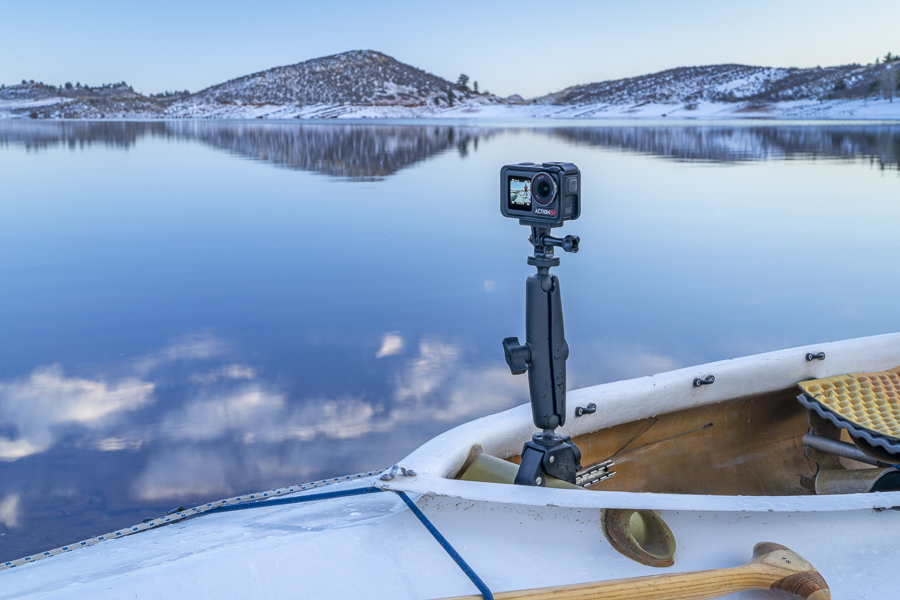
    I use a DJI Action 5 camera mounted with RAM mounts – on my bike’s handlebar, inside the cockpit of my Sea Wind canoe, or just above the mirror on my Liteboat rowing shell. Occasionally, I test other setups using SeaSucker or Neewer suction mounts to capture new angles. In the past I used GoPro cameras. Sometimes, I am using Sony RX0 II camera, but mostly for still images or static video, especially, with a partially submerged camera.

    • GoPro Hero 10 action camera mounted  on a paddleboard

    These recordings have evolved into four categories of video content, shared on YouTube and Kinomap:


    1. Outdoor Scenery for Indoor Workouts

    If you enjoy the idea of “training through nature,” this playlist might be for you. These longer videos (up to 1 hour) feature real paddling, rowing or biking sessions with ambient sounds (paddling/rowing), some text commentary and music from Epidemic Sound. Ideal for indoor rowing, cycling, or just watching to feel immersed in nature.


    2. Virtual Training with GPS and Heart Rate (on Kinomap)

    These are interactive, data-driven training videos for use with rowing, cycling, or running machines. Each session includes GPS tracks and HRM (heart rate monitor) data, synced with the video in real time. No music – just the natural sound of the activity and terrain.


    3. 10 Minutes of Relaxation (YouTube Series)

    My newest video series is designed for quick, calming breaks. These 10-minute POV videos combine real paddling or rowing footage with the soothing sound of the paddle or oars, gentle ambient music, and peaceful scenery. Great for stress relief, quiet focus, or simply unwinding.


    4. Inspirational Shorts for Aging Athletes

    I also create short 2–4 minute videos exploring themes like realistic optimism, resilience, self-forgiveness, and movement as medicine—all from the perspective of an aging athlete and active senior. These include paddling or biking footage, reflective narration, and motivational ideas.


    My most recent paddling footage comes from training sessions for the Missouri River 340 (MR340) – a 340-mile nonstop endurance race I’ll be paddling this July. It’s a major challenge and a key part of my training and motivation this year.

    If you’re using any of these videos for your indoor workouts, mental breaks, or just to connect with nature from home, I’d love to hear about it! Feel free to leave a comment or message me directly.

    Thanks for following along in this journey.
  • Horizontal or/and Vertical Format in Kayak Photography

    Horizontal or/and Vertical Format in Kayak Photography

    This article was originally posted in May of 2009. Horizontal pictures usually work better on websites and on most of social media. There are exceptions, like Instagram where is better to post square or vertical images. Well, if you are shooting for a magazine cover is a different story.

    There are a lot of books on composition in photography and the art of seeing. My favorites include books by Michael Freeman, Art Wolfe and Freeman Patterson.

    Like most paddlers I have a tendency to shoot pictures in a horizontal (landscape) format. It is more tricky to shoot in a vertical format from my tippy kayaks, especially, when I have to use a paddle to stabilize my camera.

    Some subjects simply require the vertical (portrait) format. Sometimes the choice is not so obvious. Of course, the best solution is to shoot several pictures in both formats.

    I posted below a few couples of pictures shot from the same spot in both vertical and horizontal formats. In all situations the traditional horizontal format work pretty well. However, the vertical framing allows me to show better an interesting sky or something dramatic in a foreground. Older pictures (2007) were shot with Pentax Optio W10, while newer (2009) with Optio W30 camera.

    Horizontal or vertical? Which image version do you prefer in each case?

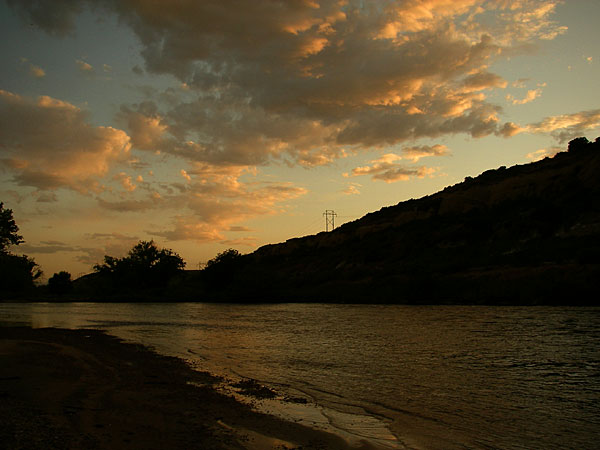
    Sunset over the South Platte River Sunset over the South Platte River

    Sunset over the South Platte River at Wildcat Mound
    below confluence with the St Vrain Creek. June 2007.


    Horsetooth Reservoir sunset Horsetooth Reservoir sunset

    Sunset over the Horsetooth Reservoir near Fort Collins shot from Thunderbolt-x kayak. June 2007.


    Lonetree Reservoir Lonetree Reservoir

    Calm evening with Sea Wind canoe on the Lonetree Reservoir near Loveland. May 2009.


    Lonetree Reservoir Lonetree Reservoir, Colorado

    The same location as above, but shot blind from over my head. I would prefer to place a horizon lower or higher in the vertical picture. The horizon exactly in the middle of the frame may work better in a more static horizontal composition. May 2009.


    wildwater racing kayak wildwater racing kayak

    Jeremy Rodgers in a wildwater racing kayak below the Plumb Ditch Dam on the South Platte River. March 2009.


  • 6 Sunset Pictures from 10 Minutes of Paddling on Boyd Lake

    6 Sunset Pictures from 10 Minutes of Paddling on Boyd Lake

    Here is another composition exercise from the old blog posted originally in June 2007. It is good to use a waterproof camera, especially, when you are paddling a tippy boat. And, always keep that camera on a leash. Usually, I have a camera tethered to my life jacket.

    10 years ago I was paddling with Pentax Optio W10, and now with a similar Olympus STYLUS Tough TG-5. I switched mostly because the new camera offers RAW format for picture recording, so I have a full control in postprocessing. For a more casual shooter this may be not so important.


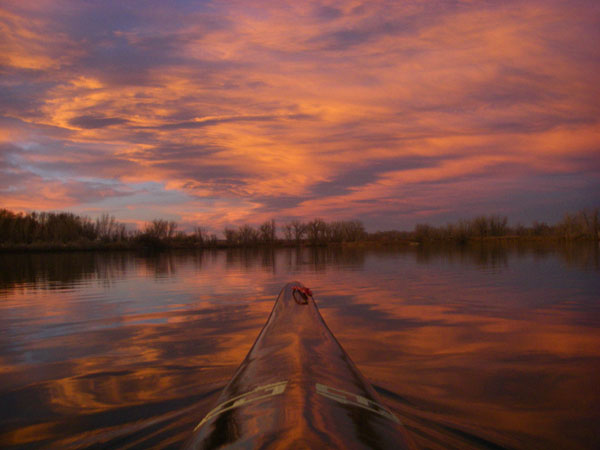
    Of course, I paddled much longer on the Boyd Lake, but I stopped for 10 minutes in the southern end of the lake to enjoy a magic light just before sunset. I shot several pictures looking north trying different angles, different placement of a horizon, with and without a kayak bow in the frame and switching from horizontal to vertical format. All pictures were shot with Pentax Optio W10 with EV compensation set between -1 and and -1.7 and white balance left on “auto”.


    Boyd Lake, Colorado

    Boyd Lake, Colorado

    Boyd Lake, Colorado

    Boyd Lake, Colorado

    Boyd Lake, Colorado

    Boyd Lake, Colorado

    The above 6 pictures were selected from 20+ pictures I shot during that 10 minute photo session. The light was changing. You can see these young flooded cottonwood trees in the light at first, then they went into shadow. It looks quiet and calm, but passing power boats were sending wakes to my tippy photography platform – WSBS Thunderbolt-X kayak. It would be rather embarrassing to flip over in 1 foot deep water.

    Then, it was time to look west and shoot the sun and clouds over mountains, but that is another photo story …

    Which is your favorite picture?

    Related posts and links:

  • 7 Tips for Photographing Paddlers

    7 Tips for Photographing Paddlers

    I would like to remind you this old post, How Did you Shoot It? with some updates and revisions. It was written two years ago as part of ProBlogger’s group writing project – “How to …” I hope that these tips are still useful. They represent quite well my own approach to paddling photography.


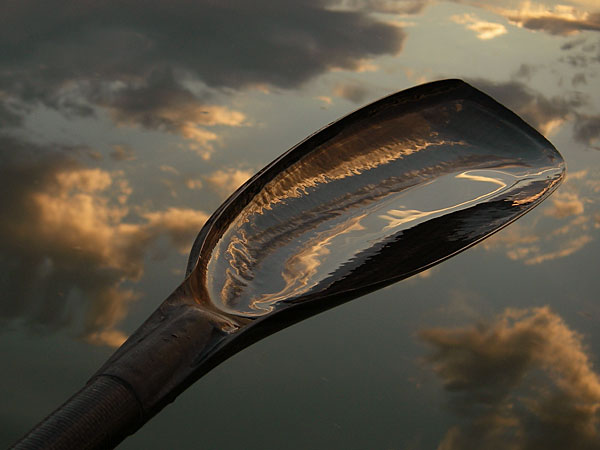
    After posting the above picture, “Paddling in Clouds”, I’ve got several questions: How did you do it? And, I had troubles to provide a reasonable answer since the shot was technically really trivial.

    Finally, I figured out that it is more about seeing pictures than about shooting and wrote these more general comments.

    1. Look and See

    Learn to see pictures. You do not need a camera to practice it. I am often “shooting” without camera, especially, when driving: that would be a good picture, this old barn would look great at sunrise, that dust devil at a horizon can be seen only through polarized glasses.

    I believe that looking at photographs in magazines, books and calendars also help to develop your seeing capability. I am checking all new photography books arriving to my university library and browsing most of photography magazines in a local bookstore.

    There are several good books on the art of seeing. Freeman Patterson comes to my mind first. Recently, I spent a lot of time with Photographer Eye by Michael Freeman.

    2. Have a Camera

    A photographer is shooting pictures, not a camera, but you should have your camera ready. “Ready” means not only accessible. You should be familiar with your camera settings and operations. Learn what camera settings are working for your paddling photography. It may be difficult to figure out camera features when sitting in a tippy kayak and waves are splashing.

    Compact waterproof digital cameras like Pentax Optio “W” or Olympus Stylus “SW” revolutionized my kayak photography. I can shoot pictures I was not able to execute before, e.g., with a partially submerged camera. I am ready to sacrifice some camera features or to some extend a picture quality for convenience and accessibility of these tiny camera for paddling environment.

    3. Be Aware of Light

    The best light for outdoor photography is when the sun is low, i.e., around sunrise and sunset. I know that I can expect interesting light at the end of my afternoon paddling workout. If the sunset is not very exciting I can shoot water reflections or a tree silhouette.

    Ironically, on paddling trips, we are often passing the best scenery in the middle of day, when the light is harsh and unpleasant. I am still shooting some snapshots for documentary purposes. My primary motivation to start paddling fast kayaks was to get in time to my shooting spots. All that racing craziness came later …

    4. Point (compose) and Shoot

    Do not be afraid to shoot without viewfinder. Well, you don’t have one in Pentax Optio. And, the LCD display is often difficult to read in a bright sun. It shouldn’t stop you from shooting. Use some creative angles as far as you can extend your arm. Remember, you can put this camera under water next to you kayak. The lack of a viewfinder is perhaps the main reason preventing some photographers from buying this camera, but I think that this a reasonable compromise in the camera of this size.

    I didn’t have a clear view of the camera display when shooting my “Paddling in Clouds” picture. I was just trying to keep a paddle diagonally in my frame.

    foggy sunrise over Suwannee River, Florida

    5. Shoot Multiple Frames

    Shooting pictures with a digital camera is cheap. You do not need to worry about film cost. You can always erase the picture and shoot again unless you are after some action shots. So, do not be afraid to experiment and shoot even if you do not see the image in your LCD monitor. Shoot some extra frames. It is helpful to have an adequate memory card.

    I shot about 30 frames trying to catch a sky reflection in water and in my paddle. However, I would show not more than 3 or 4 from those 30 frames.

    6. Practice

    The more you shoot the better you should get. I have shot similar pictures before including reflections and a paddle.

    Review your pictures on the camera LCD if possible. Check the histogram. Analyze your shots after paddling on a computer screen. You have all information about camera setting included in each digital image file. Try to figure out what worked and what not. Learn from mistakes.

    7. Have Fun

    I don’t consider myself a professional photographer. When paddling I am shooting what I like just for fun. Documenting my paddling trips and races is still fun. I feel free to experiment.

    The great Alfred Stieglitz was an amateur photographer too. Anyway, the photography is not a profession

    Sometimes I sell a picture to a magazine or donate to a book cover. A year ago, I started to sell my pictures through microstock agencies. I am just taking more often my DSLR camera and a tripod for paddling.

  • Paddling CLC Patuxent Kayak with a Telescoping Camera Mast

    Paddling CLC Patuxent Kayak with a Telescoping Camera Mast


    April 2010. Paddling CLC Patuxent 19.5 kayak with Canon Powershot G11 camera mounted on a telescoping mast assembled from a monopod and sticky pod platform.

    Related post:
    Paddling with Canon PowerShot G11 Camera on a Monopod Mast
    Kayak Video Camera Mast – Sticky Pod Combined with Monopod
    A Bird’s-Eye View of Kayaking with GoPro Hero Camera

  • Paddling Photography in April (2005-2008)

    I am trying to return back to my older articles through “Paddling Photography a Year Ago” series. However, I am running this blog for over 5 years. So, today, I offer a look at selected April posts over the recent 4 years. I am writing a similar post in my Fitness Paddling blog as well.


    Big Thompson River below Loveland
    Big Thompson River below Loveland

    2005

    Paddling and Exploring the Big Thompson River below Loveland, Colorado
    Big Thompson River from I-25 to Hillsboro Dam
    Paddling Upstream Can Be Faster than Downstream – Hail Storm on the Big Thompson
    First Impressions of New Waterproof Camera – Pentax Optio WP
    Big Thompson River with a New Pentax Optio WP Camera

    North Platte River above Seminoe Reservoir in Wyoming
    North Platte River above Seminoe Reservoir in Wyoming

    2006

    No Viewfinder? 10 Tips on Shooting Pictures without Viewfinder
    North Platte River in Wyoming above Seminoe Reservoir

    Horsetooth Reservoir
    Dear skull on the shore of Horsetooth Reservoir

    2007

    Ez-Vee Roof Racks from Kayak Pro – Review
    Anybody Remembers C1 Canoe Racing on the South Platte River near Greeley?
    Launching Thunderbolt Kayak on Horsetooth Reservoir from Lory State Park
    20 Paddling and Photography Destinations – Wayfarer Trip Index
    Paddling the Skeleton Coast
    10 Tips How to Avoid Blurry Pictures when Shooting on Water
    Blue Paddle from New Belgium through a Pinhole
    Racing Kayaker and a Paddle Stroke – 4 Pictures by Björn Olin


    Horsetooth Reservoir
    Quarry Cove of the Horsetooth Reservoir

    2008

    Springtime Paddling on the Horsetooth Reservoir
    Paddling the Horsetooth Reservoir and Looking for the Past


  • Kayak Video Camera Mast – Sticky Pod Combined with Monopod

    As many other paddlers I was inspired by a video camera setup used by Justine Curgenven in her This Is The Sea DVD series. So, last year, I started to experiment with my own mast for kayak photography and video. My idea was to combine the sticky pod suction cup camera mount with a telescoping 50′ monopod. However, I did not want to make any permanent modifications to my rather expensive, 6 segment Carbon Fiber Traveler Monopod by Gitzo. It is just another job for my Gitzo.

    This is “my sticky pod” – a camera mount with 3 suction cups. It comes with a mounting 3/8″ bolt. My Gitzo monopod and photo tripod heads have 1/4″ sockets, so I drilled an extra hole and I added 1/4″ bolt. The first thing I added was a tether!

    Note that the original bolts and rivets are getting a little bit rusty. It would be nice to have stainless hardware for a wet environment. The triangular base is made of aluminum.


    I removed a head from my Gitzo monopod and screwed it upside down to the sticky pod. You can use any monopod, just be sure that is has 3/8″ or 1/4″ socket. Aluminum monopods are not very expensive, starting around $20.

    Now, we need to attach a camera to the other side (i.e., normally bottom) of the monopod. As a temporary solution I used a small toy tripod with flexible legs and some plastic wraps. I believe I got that tripod together with a memory card order.

    Here is my camera, Pentax Optio W30, mounted on the mast. Don’t forget a tether!

    I added a temporary lens hood a year ago. It’s ugly, but it works protecting the lens against direct sun and water splashes.

    Flexible legs of the little tripod allow me to adjust camera position. I can shoot in both landscape and portrait mode. It’s not very robust solution however. For rough conditions I would use more solid mount to prevent camera movement or just more plastic wraps or even a duct tape.

    The camera mast mounted on the stern deck of my Thunderbolt-X kayak. It is almost fully extended and even with a light Pentax Optio camera affects stability of my tippy kayak. A few inches lower and the kayak behaves much better.

    One example of picture shot from the back deck with a fully extended mast – paddling Thunderbolt kayak on Beaver Pond near Fort Collins. Pentax Optio W30 was set in an interval mode and was shooting pictures every 10 seconds. I was shooting with a similar camera setup last year on the Horsetooth Reservoir, but the camera was mounted much closer to a paddler.

    It is a little bit tricky to set up a camera at that tall mast without looking at a LCD monitor. Perhaps, a small mirror would be helpful.


  • Use Your Paddle to Stabilize a Camera

    stabilize camera on paddleI often use a paddle to stabilize my Pentax Optio camera, especially, when paddling rather tippy boat like Sisson Nucleus or Spencer X-treme. It serves two functions:

    1. To have your paddle ready for bracing.

    2. To avoid shaking the camera when pressing a shutter button.

    I recommend this technique for shooting with any small camera, just keep your camera on a leash and attach a piece of non-slippery material to your paddle. I also recommend to use a 2 second self timer whenever possible and reasonable.

    Of course, this method may not work if you are paddling against 30 knot wind or through rapids …


    paddling & shooting

    I was caught on video by Marcie Nolan when shooting with my Pentax Optio W10 from Sisson Nucleus kayak during warm-up before the recent Dotsero Race on the Colorado River in Glenwood Canyon.


  • Shooting Paddlers – Photographic Adventures with Canoeists, Kayakers and Rafters

    Shooting Paddlers – Photographic Adventures with Canoeists, Kayakers and Rafters

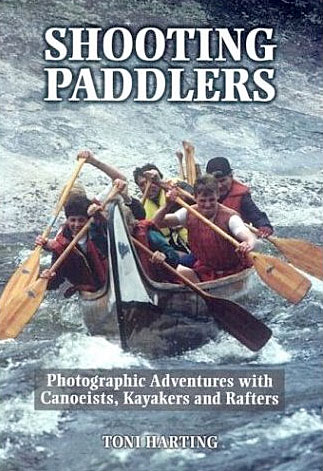
    Shooting Paddlers: Photographic Adventures with Canoeists, Kayakers and Rafters

    Shooting Paddlers: Photographic Adventures with Canoeists, Kayakers and Rafters, book by Toni Harting, a Canadian outdoor photographer, writer and canoeist. 212 pages. Cardinal Publisher’s Group, 2004.

    Toni Harting migrated to Canada from the Netherlands in 1970 and has lived in Toronto with his wife and canoeing partner, Ria, ever since. He holds two Master of Applied Science degrees in aerospace engineering, but left his consulting engineering profession in 1974 to build a new career as full time freelance photographer specializing in canoe topics, particularly wilderness canoeing.

    You can learn a lot from his book. It is designed to help all paddlers strengthen their ability to see, recognize and record meaningful images. At the same time the book is simply fun to read or browse through it.

    There are more than two hundred black and white and color pictures. Some of them are in two versions, e.g. an original picture and the same picture after cropping. Each picture is accompanied by its story and discussion with tips on composition, technique and logistics. Of course, there is also a chapter on equipment but you will not find information on a highly specialized gear, rather tips on using regular 35 mm point-and-shoot and SRL cameras.

    There are many amazing shots. You can see a lot of action pictures from canoe and kayak racing and rafting, contemplative scenic or close up shots, pictures from paddler’s life on camping or portage trail. You will not find many pictures from sea kayaking, but a great representation of a canoe including sprint and marathon canoes, voyageur canoes and dragon boats.

    My picture of a paddle in my another weblog entry was inspired by one of Toni Harting photos. I just need to work more on that shot… And, I got some more photo ideas from his book.

    I always admire people who have sacrificed their “other” career to be a full time photographer. I know enough about photography to recognize how hard photographer job is and that it is not only about shooting pictures. Writing skills help for sure.

    Outdoor and action adventure photography books:

    />

    Related posts and links: