Tag: composition

  • Horizontal or/and Vertical Format in Kayak Photography

    Horizontal or/and Vertical Format in Kayak Photography

    This article was originally posted in May of 2009. Horizontal pictures usually work better on websites and on most of social media. There are exceptions, like Instagram where is better to post square or vertical images. Well, if you are shooting for a magazine cover is a different story.

    There are a lot of books on composition in photography and the art of seeing. My favorites include books by Michael Freeman, Art Wolfe and Freeman Patterson.

    Like most paddlers I have a tendency to shoot pictures in a horizontal (landscape) format. It is more tricky to shoot in a vertical format from my tippy kayaks, especially, when I have to use a paddle to stabilize my camera.

    Some subjects simply require the vertical (portrait) format. Sometimes the choice is not so obvious. Of course, the best solution is to shoot several pictures in both formats.

    I posted below a few couples of pictures shot from the same spot in both vertical and horizontal formats. In all situations the traditional horizontal format work pretty well. However, the vertical framing allows me to show better an interesting sky or something dramatic in a foreground. Older pictures (2007) were shot with Pentax Optio W10, while newer (2009) with Optio W30 camera.

    Horizontal or vertical? Which image version do you prefer in each case?

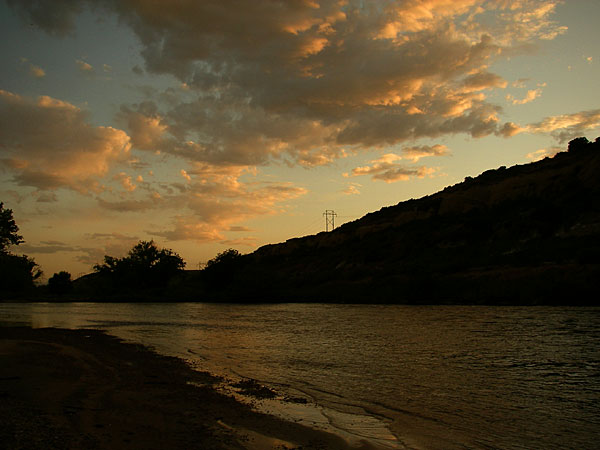
    Sunset over the South Platte River Sunset over the South Platte River

    Sunset over the South Platte River at Wildcat Mound
    below confluence with the St Vrain Creek. June 2007.


    Horsetooth Reservoir sunset Horsetooth Reservoir sunset

    Sunset over the Horsetooth Reservoir near Fort Collins shot from Thunderbolt-x kayak. June 2007.


    Lonetree Reservoir Lonetree Reservoir

    Calm evening with Sea Wind canoe on the Lonetree Reservoir near Loveland. May 2009.


    Lonetree Reservoir Lonetree Reservoir, Colorado

    The same location as above, but shot blind from over my head. I would prefer to place a horizon lower or higher in the vertical picture. The horizon exactly in the middle of the frame may work better in a more static horizontal composition. May 2009.


    wildwater racing kayak wildwater racing kayak

    Jeremy Rodgers in a wildwater racing kayak below the Plumb Ditch Dam on the South Platte River. March 2009.


  • 6 Sunset Pictures from 10 Minutes of Paddling on Boyd Lake

    6 Sunset Pictures from 10 Minutes of Paddling on Boyd Lake

    Here is another composition exercise from the old blog posted originally in June 2007. It is good to use a waterproof camera, especially, when you are paddling a tippy boat. And, always keep that camera on a leash. Usually, I have a camera tethered to my life jacket.

    10 years ago I was paddling with Pentax Optio W10, and now with a similar Olympus STYLUS Tough TG-5. I switched mostly because the new camera offers RAW format for picture recording, so I have a full control in postprocessing. For a more casual shooter this may be not so important.


    Of course, I paddled much longer on the Boyd Lake, but I stopped for 10 minutes in the southern end of the lake to enjoy a magic light just before sunset. I shot several pictures looking north trying different angles, different placement of a horizon, with and without a kayak bow in the frame and switching from horizontal to vertical format. All pictures were shot with Pentax Optio W10 with EV compensation set between -1 and and -1.7 and white balance left on “auto”.


    Boyd Lake, Colorado

    Boyd Lake, Colorado

    Boyd Lake, Colorado

    Boyd Lake, Colorado

    Boyd Lake, Colorado

    Boyd Lake, Colorado

    The above 6 pictures were selected from 20+ pictures I shot during that 10 minute photo session. The light was changing. You can see these young flooded cottonwood trees in the light at first, then they went into shadow. It looks quiet and calm, but passing power boats were sending wakes to my tippy photography platform – WSBS Thunderbolt-X kayak. It would be rather embarrassing to flip over in 1 foot deep water.

    Then, it was time to look west and shoot the sun and clouds over mountains, but that is another photo story …

    Which is your favorite picture?

    Related posts and links:

  • Where to Place a Horizon in Your Paddling Pictures?

    Where to Place a Horizon in Your Paddling Pictures?

    I am revising another old blog post on photography composition. It was originally published in October, 2007.


    The horizon line is perhaps the most important composition element in paddling pictures, especially, in those shot from a kayak in open water. You can achieve quite different effects depending on the horizon placement within your picture frame.

    During my recent evening paddling on the Beaver Pond in Arapaho Bend Natural Area near Fort Collins, Colorado, I had a great light, an interesting, fast changing sky, and nice fall colors. I shot many pictures with my Pentax Optio W10 camera trying different compositions of the same scene. Shooting from the tippy Thunderbolt kayak was quite challenging, but fun.

    Here are 7 examples from my photo paddling session with comments on the composition and the horizon placement. I am posting pictures in the vertical format to avoid the “horizontal or vertical” question.

    1.

    Let’s stop in the middle of my lake and shoot some pictures.

    The first shot is a “classic” composition with the horizon around the lower 1/3 of the picture following the Rule of Thirds. The emphasis is on the sky, but the water with reflections and ripples also has a strong impact.

    Well, this sky is not that dramatic after all. What about more water here.

    paddling in Colorado

    2.

    My kayak was slowly gliding forward, but the next picture was taken from the almost the same position.

    This time the horizon was placed high in the frame (even above 2/3). The emphasis is on the water with reflections. I like how the water ripples look at this shooting angle. Notice the difference in comparison to the previous shot.

    What is missing in this picture? Something small in the foreground. A bigger water ripple? A floating gold leaf? That would be ideal. I found that leaf later.

    paddling in Colorado

    3.

    Let’s add a kayak to the scene. The horizon went even more up to show the bow of my Thunderbolt. The water ripples do not look so nice from this shooting angle.

    I prefer these kind of shots to be perfectly symmetrical or with the kayak placed more along diagonal. My favorite “kayak bow” picture is shot from the water level on a kayak side like that one from the Boyd Lake. Actually, my original composition here was symmetrical, but the horizon was tilted and I needed to slightly rotate the picture.

    A bow wake would be nice in my shot here. The kayak looks somehow disconnected from the water. I believe that the light was still too harsh to show the kayak deck. The picture is OK, but not great.

    So, let’s keep paddling …

    paddling in Colorado

    4.

    One more lap around the lake.

    The clouds and sky are changing all time.

    Another shot with the horizon low in the picture frame. There was nothing very exciting in the water, but the sky was worth to capture. A nice paddling picture.

    paddling in Colorado

    5.

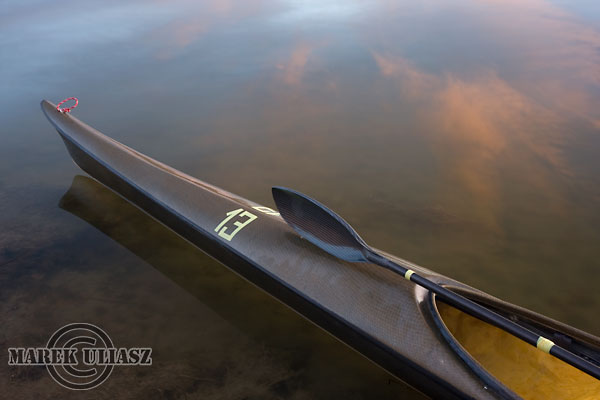
    Let’s go closer to the shore, so we can see some reflections of cottonwood trees in the kayak deck. Perhaps, it is too much of the kayak included in my frame here, but I really wanted to cover those reflections.

    Should I remove the number “13” from my kayak deck? I put it there before the Kansas River “Fitty Gritty” race in June. It is just a yellow electric tape, but, maybe, it adds some character to my kayak?

    paddling in Colorado

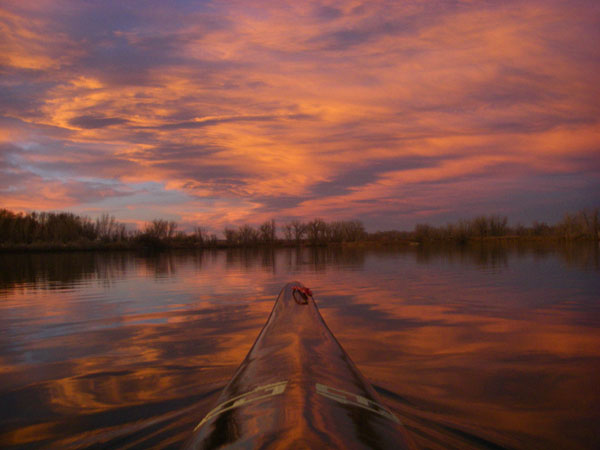
    6.

    What about breaking the Rule of Thirds and place the horizon exactly in the middle of the frame? This usually results in a more static and calm composition. The photo tips for beginners usually warn you not to do it.

    Well, I just like shooting those static, symmetrical pictures, but rather in a horizontal format. However, I needed the vertical format here to show both clouds and their reflections in the lake.
    I believe that the kayak bow adds some dynamics to the scene.

    It would be interesting to shoot the same scene at higher kayak speed with more of a bow wake. I would rather mount the camera on the kayak deck for this purpose and shoot in the interval mode. I have not tried the vertical format with the deck mounted camera yet.

    paddling in Colorado

    7.

    Sometimes, we just don’t need the horizon in the picture frame at all. The water provides enough interest.

    But, that was another paddling evening with another kayak – Sisson Nucleus. It is interesting that the white hull of Sisson and the black hull of Thunderbolt kayak look the same after sunset. They both work as a reflective mirror.

    Please let me know if you find this type of blog posts useful. I can certainly write more comments about my paddling pictures.

    And, please provide comments for specific pictures discussed here, especially, if your interpretation or suggestions for improvements differs from mine.

    Related posts and links:

  • 7 Tips for Photographing Paddlers

    7 Tips for Photographing Paddlers

    I would like to remind you this old post, How Did you Shoot It? with some updates and revisions. It was written two years ago as part of ProBlogger’s group writing project – “How to …” I hope that these tips are still useful. They represent quite well my own approach to paddling photography.


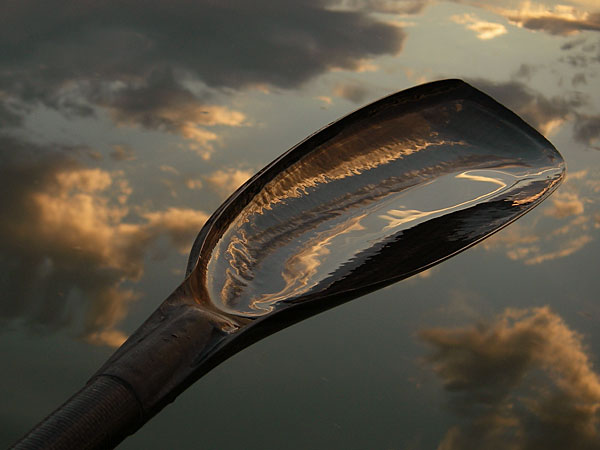
    After posting the above picture, “Paddling in Clouds”, I’ve got several questions: How did you do it? And, I had troubles to provide a reasonable answer since the shot was technically really trivial.

    Finally, I figured out that it is more about seeing pictures than about shooting and wrote these more general comments.

    1. Look and See

    Learn to see pictures. You do not need a camera to practice it. I am often “shooting” without camera, especially, when driving: that would be a good picture, this old barn would look great at sunrise, that dust devil at a horizon can be seen only through polarized glasses.

    I believe that looking at photographs in magazines, books and calendars also help to develop your seeing capability. I am checking all new photography books arriving to my university library and browsing most of photography magazines in a local bookstore.

    There are several good books on the art of seeing. Freeman Patterson comes to my mind first. Recently, I spent a lot of time with Photographer Eye by Michael Freeman.

    2. Have a Camera

    A photographer is shooting pictures, not a camera, but you should have your camera ready. “Ready” means not only accessible. You should be familiar with your camera settings and operations. Learn what camera settings are working for your paddling photography. It may be difficult to figure out camera features when sitting in a tippy kayak and waves are splashing.

    Compact waterproof digital cameras like Pentax Optio “W” or Olympus Stylus “SW” revolutionized my kayak photography. I can shoot pictures I was not able to execute before, e.g., with a partially submerged camera. I am ready to sacrifice some camera features or to some extend a picture quality for convenience and accessibility of these tiny camera for paddling environment.

    3. Be Aware of Light

    The best light for outdoor photography is when the sun is low, i.e., around sunrise and sunset. I know that I can expect interesting light at the end of my afternoon paddling workout. If the sunset is not very exciting I can shoot water reflections or a tree silhouette.

    Ironically, on paddling trips, we are often passing the best scenery in the middle of day, when the light is harsh and unpleasant. I am still shooting some snapshots for documentary purposes. My primary motivation to start paddling fast kayaks was to get in time to my shooting spots. All that racing craziness came later …

    4. Point (compose) and Shoot

    Do not be afraid to shoot without viewfinder. Well, you don’t have one in Pentax Optio. And, the LCD display is often difficult to read in a bright sun. It shouldn’t stop you from shooting. Use some creative angles as far as you can extend your arm. Remember, you can put this camera under water next to you kayak. The lack of a viewfinder is perhaps the main reason preventing some photographers from buying this camera, but I think that this a reasonable compromise in the camera of this size.

    I didn’t have a clear view of the camera display when shooting my “Paddling in Clouds” picture. I was just trying to keep a paddle diagonally in my frame.

    foggy sunrise over Suwannee River, Florida

    5. Shoot Multiple Frames

    Shooting pictures with a digital camera is cheap. You do not need to worry about film cost. You can always erase the picture and shoot again unless you are after some action shots. So, do not be afraid to experiment and shoot even if you do not see the image in your LCD monitor. Shoot some extra frames. It is helpful to have an adequate memory card.

    I shot about 30 frames trying to catch a sky reflection in water and in my paddle. However, I would show not more than 3 or 4 from those 30 frames.

    6. Practice

    The more you shoot the better you should get. I have shot similar pictures before including reflections and a paddle.

    Review your pictures on the camera LCD if possible. Check the histogram. Analyze your shots after paddling on a computer screen. You have all information about camera setting included in each digital image file. Try to figure out what worked and what not. Learn from mistakes.

    7. Have Fun

    I don’t consider myself a professional photographer. When paddling I am shooting what I like just for fun. Documenting my paddling trips and races is still fun. I feel free to experiment.

    The great Alfred Stieglitz was an amateur photographer too. Anyway, the photography is not a profession

    Sometimes I sell a picture to a magazine or donate to a book cover. A year ago, I started to sell my pictures through microstock agencies. I am just taking more often my DSLR camera and a tripod for paddling.