Tag: photography

  • Beautiful Calm Sunrise over Missouri River at Dalton Bottoms

    Beautiful Calm Sunrise over Missouri River at Dalton Bottoms

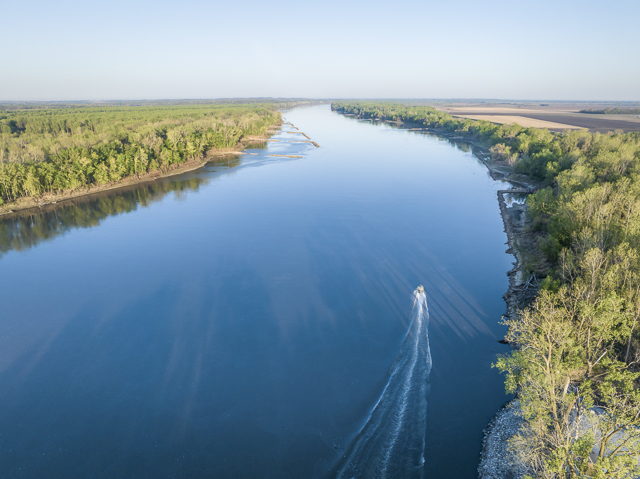
    On my recent trip to Missouri to participate in the Mean Lamine race, I took some time to revisit various places along the Missouri River. Despite less-than-ideal weather conditions, I was fortunate enough to witness a nice sunrise at the Dalton Bottoms river access.

    During the Missouri River 340 race, I usually paddle this section of the river at night and often take a short break at the Dalton Bottoms ramp for some rest: arriving after midnight, and leaving well before sunrise.  In earlier years, I used to be the only one there, but now it’s quite popular among racers and their support teams. However, during my visit in late April, Dalton Bottoms was serene and peaceful, with only one fishing boat arriving shortly after sunrise. I spent some time there shooting pictures and video. You are welcome to check a small slideshow of my favorite shots.

    • calm spring dawn over Missouri River at Dalton Bottoms, springtime scenery
    • spring sunrise over the Missouri River at Dalton Bottoms
    • spring sunrise over Missouri River and a boat ramp at Dalton Bottoms
    • spring sunrise over the Missouri River at Dalton Bottoms - aerial view
    • spring sunrise over the Missouri River at Dalton Bottoms, MO
    • launching a fishing boat at a ramp - sunrise aerial view of Missouri River at Dalton Bottoms
    • fishing boat at a ramp - sunrise aerial view of Missouri River at Dalton Bottoms
    • fishing boat leaving a ramp - sunrise aerial view of Missouri River at Dalton Bottoms
    • spring sunrise over the Missouri River with a fishing boat at Dalton Bottoms - aerial view
    • river access with a boat ramp - sunrise aerial view of Missouri River at Dalton Bottoms
    • spring sunrise over the Missouri River at Dalton Bottoms - aerial view
    • Toyota 4Runner SUV with a performance stand up paddleboard (Starboard Waterline) on roof racks at a shore of the MIssouri River in spring scenery, aerial view.

    I will probably stop at Dalton Bottoms again in August during the 2023 MR 340 race unless I manage to paddle all the way to Glasgow for my first longer rest stop.

    Related posts:

  • Blue Stand Up Paddling in Arapaho Bend Natural Area

    Blue Stand Up Paddling in Arapaho Bend Natural Area

    paddling in blue: blue sky, blue paddleboard, blue paddler, blue leash ...?

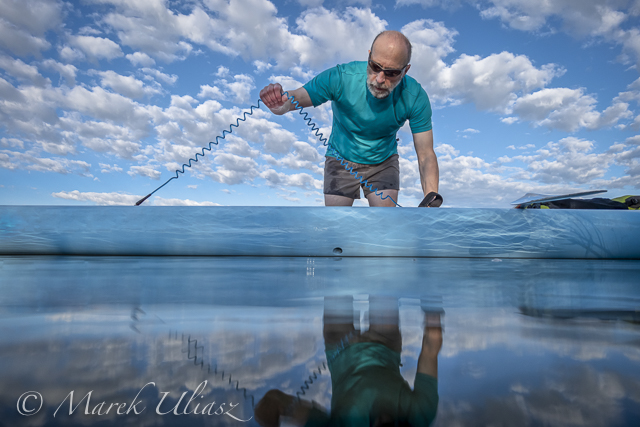
    Paddling in blue: blue sky, blue paddleboard, blue paddler, blue leash … Happy accident or conscious color selection? I am not sure.

    This picture in from my morning paddling in May on Beaver Pond in Arapaho Bend Natural Area, one of many natural areas in Fort Collins along the Poudre River. It was shot with Sony RX0-2 camera from a water level. The camera was probably partially submerged. This low angle gives very nice reflections, but the result is always quite unpredictable.

    small waterproof action camera in a rugged cage

    The paddleboard is not recognizable above, but it is 17.6’x24″ Mistral Stealth, my favorite board in 2020.

    You can find more of my recent pictures from paddling on instagram, but I will try to share some stories here.

    Related posts:
  • Winter Stand Up Paddling on Horsetooth Reservoir

    Winter Stand Up Paddling on Horsetooth Reservoir

    I love paddling on the Horsetooth Reservoir in cold season. Boat ramps are closed, no power boat traffic, usually quiet and calm. Snow and ice can enhance scenery. A great time to paddle, train, relax or photograph.

    The Horsetooth stays ice free longer than Boyd Lake or smaller lakes in Fort Collins like Beaver Pond in Arapaho Bend Natural Area. South Bay freezes first, and than smaller coves. Don’t get discouraged by a webcam showing the South Bay. Very often you can still find open water in northern end of the reservoir at Satanka Cove.

    In some years, I was able to paddle Horsetooth for the entire winter, in others till February. This winter season is somewhat unusual because water level is very high.

    Earlier in a cold season I am using a wet suit, and later I am switching to supskin drysuit. I always paddle in life jacket and safety leash on paddleboards. I also carry the spot device for emergency, and always some sort of photo equipment.

    This winter I am paddling mostly various stand up paddleboards and sometimes my expedition canoe.

    Here are some pictures and comments from my paddling in 2019/2020 season. What is your experience from paddling Horsetooth Reservoir in winter? Any practical tips?


    Horsetooth Reservoir in winter
    Horsetooth Reservoir in February 2020 as seen from a parking lot at Satanka Cove. A tip of that peninsula is a good place to launch when the cove is covered by ice. You can also take a shorter, but steeper walk towards the end of Horsetooth Dam.

    racing stand up paddleboard in winter
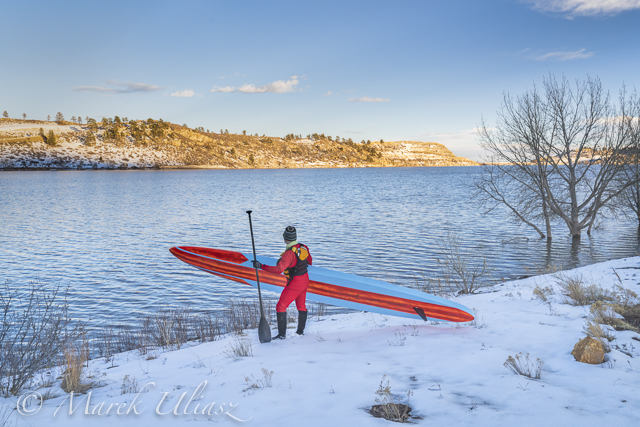
    A few time in late fall I launched my paddleboards from the Lory State Park at Soldier Cove. It’s a pretty short walk (~200 steps) to water protected from winds. Of course, later in winter is not an option. The picture above shows my last launch of 14’X26″ All Star by Starboard SUP there on January 12. It involved some walks around ice fields.


    carrying SUP
    Occasionally, I am taking a walk between Satanka and North Eltuck Cove, just for fun and photography. Let’s call it cross training.

    hot tea during winter paddling
    A thermos bottle with hot tea belongs to my standard equipment in winter paddling, since I often take longer breaks for photography. Usually, it happen close to sunset when it’s getting pretty chilly.

    SUP paddler in drysuit on mountain lake
    Experimenting with a low angle POV from a partially submerged action camera – Sony RX0 2. That camera has a narrower angle of view than GoPro and it doesn’t work so well as a bow camera on a 14′ paddleboard. A longer board needed!


    Satanka Cove. First paddling in a snow blizzard. A great opportunity for photography.


    Paddling along icy cliff in Sea Wind, a heavy duty expedition canoe designed and build by legendary Verlen Kruger. This boat is a great icebreaker, but it’s much easier and faster to load SUP on roof racks.


    February 15. Northern part of the lake was still open. Trying a new board in icy conditions: 17.6’x24″ Mistral Interceptor. I needed something to much my Santa drysuit


    The long, unlimited paddleboard (~35 lb) is more awkward to carry around than 14′ boards. And, even a safety leash attached makes it tail heavy.


    Related paddling links:

    Do you need a hot tea for your winter paddling?

    Winter Season Paddling on Horsetooth Reservoir with Sea Wind Canoe

    Icy Horsetooth Reservoir – Opening Lake Paddling Season

  • Horizontal or/and Vertical Format in Kayak Photography

    Horizontal or/and Vertical Format in Kayak Photography

    This article was originally posted in May of 2009. Horizontal pictures usually work better on websites and on most of social media. There are exceptions, like Instagram where is better to post square or vertical images. Well, if you are shooting for a magazine cover is a different story.

    There are a lot of books on composition in photography and the art of seeing. My favorites include books by Michael Freeman, Art Wolfe and Freeman Patterson.

    Like most paddlers I have a tendency to shoot pictures in a horizontal (landscape) format. It is more tricky to shoot in a vertical format from my tippy kayaks, especially, when I have to use a paddle to stabilize my camera.

    Some subjects simply require the vertical (portrait) format. Sometimes the choice is not so obvious. Of course, the best solution is to shoot several pictures in both formats.

    I posted below a few couples of pictures shot from the same spot in both vertical and horizontal formats. In all situations the traditional horizontal format work pretty well. However, the vertical framing allows me to show better an interesting sky or something dramatic in a foreground. Older pictures (2007) were shot with Pentax Optio W10, while newer (2009) with Optio W30 camera.

    Horizontal or vertical? Which image version do you prefer in each case?

    Sunset over the South Platte River Sunset over the South Platte River

    Sunset over the South Platte River at Wildcat Mound
    below confluence with the St Vrain Creek. June 2007.


    Horsetooth Reservoir sunset Horsetooth Reservoir sunset

    Sunset over the Horsetooth Reservoir near Fort Collins shot from Thunderbolt-x kayak. June 2007.


    Lonetree Reservoir Lonetree Reservoir

    Calm evening with Sea Wind canoe on the Lonetree Reservoir near Loveland. May 2009.


    Lonetree Reservoir Lonetree Reservoir, Colorado

    The same location as above, but shot blind from over my head. I would prefer to place a horizon lower or higher in the vertical picture. The horizon exactly in the middle of the frame may work better in a more static horizontal composition. May 2009.


    wildwater racing kayak wildwater racing kayak

    Jeremy Rodgers in a wildwater racing kayak below the Plumb Ditch Dam on the South Platte River. March 2009.


  • Snapshot from a Life of Paddling Photographer

    Snapshot from a Life of Paddling Photographer

    8 hours in front of a computer. Processing pictures and video clips, describing, keywording and submitting to stock agencies. 4pm: My computer is busy uploading videos and I am driving into the Poudre Canyon.

    kayak, packraft and paddler aerial view

    Here I am in my field office on the Poudre River below Mad Dog Rapid. A two days earlier my outdoor studio wast at the Picnic Rock.

    inflatable whitewater kayak aerial view

    Kayak. Packraft. Camera. Drone. One man operation. Paddling in circles. Wet and cold bottom. Interval shooting. Video shooting. Drone shooting. Taking off and landing on rocks under trees. Drone crashed, broken propeller. Light is changing. My dog is barking for attention. Milo doesn’t like to be tied to a tree when I am more than 10 steps away. Too much stuff. Too much action. Fun! Sort of …

    inflatable whitewater kayak

    8pm: I am back home exhausted. Uploading all images and video to a computer. It’s a lot of stuff from interval shooting which needs to be sorted. And … I am starting to think about my next outdoor photo session. One boat only! Perhaps, drysuit. The self bailing Aire Force kayak is getting wet even on flat water. What to do with Milo? I can take him with me only on a paddleboard or canoe.

    pumping up inflatable whitewater kayak

    As a stock photographer I am making money mostly from my studio work: product, food and conceptual images. But, I need to go outdoors to seek inspiration, recover from computer work, and protect my sanity.

    I have more 18,000 still pictures and 400 video clips in my stock portfolio. These days I am focusing on two stock agencies Adobe Stock and Shutterstock which provide together more than 60% of my income. You can find most of my video clips on Pond5 and Shutterstock. Here is my little collection of paddling clips. As you can see I am working hard to grow it.
    packraft on Poudre River


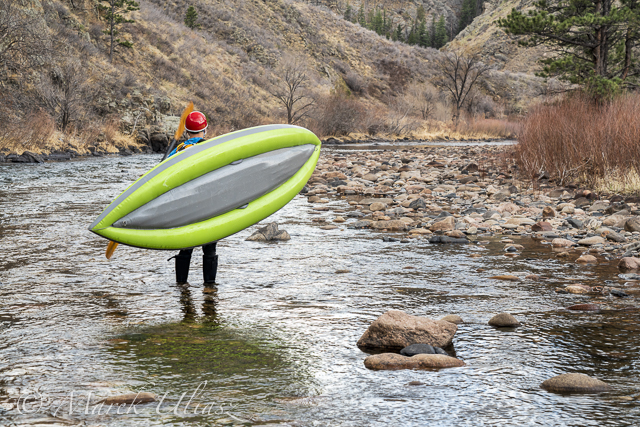
    I’ve got my Aire Force inflatable kayak a couple weeks ago from . It was a little bit cheaper than from NRS. I selected lime green color specifically for photography. It looks pretty good on a river, though, in some situations, it may appear too bright and easy to overexpose.

    Related posts:
    Alpacka Yukon Packraft on the Poudre River
    Green Ducky Project – Inflatable Kayak in Royalty Free Pictures

  • Fit2Paddle Paddling Photography on Instagram

    Fit2Paddle Paddling Photography on Instagram

    Every day I am posting pictures on Instagram. My Instagram feed is dominated by paddling, especially, SUP, but also includes images from other outdoor activities: mountain biking, hiking, inline skating and drone flying. Recent pictures were shot mostly with Sony cameras: A6000, A7R2, A7R3, some with waterproof Olympus Stylus and all aerials with DJI Phantom 4 pro drone. My Canon 5D Mark 3 camera stays in the home studio these days.

    Last year I started to race stand up paddleboards. This limited my chances to shoot pictures during actual racing. However, each race includes a long driving time which I am using for shooting including aerial video and photography.

    You are welcome to visit my Instagram and like, follow, share, comment …

    [instagram-feed]

    word abstract  - social media concept

  • 6 Sunset Pictures from 10 Minutes of Paddling on Boyd Lake

    6 Sunset Pictures from 10 Minutes of Paddling on Boyd Lake

    Here is another composition exercise from the old blog posted originally in June 2007. It is good to use a waterproof camera, especially, when you are paddling a tippy boat. And, always keep that camera on a leash. Usually, I have a camera tethered to my life jacket.

    10 years ago I was paddling with Pentax Optio W10, and now with a similar Olympus STYLUS Tough TG-5. I switched mostly because the new camera offers RAW format for picture recording, so I have a full control in postprocessing. For a more casual shooter this may be not so important.


    Of course, I paddled much longer on the Boyd Lake, but I stopped for 10 minutes in the southern end of the lake to enjoy a magic light just before sunset. I shot several pictures looking north trying different angles, different placement of a horizon, with and without a kayak bow in the frame and switching from horizontal to vertical format. All pictures were shot with Pentax Optio W10 with EV compensation set between -1 and and -1.7 and white balance left on “auto”.


    Boyd Lake, Colorado

    Boyd Lake, Colorado

    Boyd Lake, Colorado

    Boyd Lake, Colorado

    Boyd Lake, Colorado

    Boyd Lake, Colorado

    The above 6 pictures were selected from 20+ pictures I shot during that 10 minute photo session. The light was changing. You can see these young flooded cottonwood trees in the light at first, then they went into shadow. It looks quiet and calm, but passing power boats were sending wakes to my tippy photography platform – WSBS Thunderbolt-X kayak. It would be rather embarrassing to flip over in 1 foot deep water.

    Then, it was time to look west and shoot the sun and clouds over mountains, but that is another photo story …

    Which is your favorite picture?

    Related posts and links:

  • Where to Place a Horizon in Your Paddling Pictures?

    Where to Place a Horizon in Your Paddling Pictures?

    I am revising another old blog post on photography composition. It was originally published in October, 2007.


    The horizon line is perhaps the most important composition element in paddling pictures, especially, in those shot from a kayak in open water. You can achieve quite different effects depending on the horizon placement within your picture frame.

    During my recent evening paddling on the Beaver Pond in Arapaho Bend Natural Area near Fort Collins, Colorado, I had a great light, an interesting, fast changing sky, and nice fall colors. I shot many pictures with my Pentax Optio W10 camera trying different compositions of the same scene. Shooting from the tippy Thunderbolt kayak was quite challenging, but fun.

    Here are 7 examples from my photo paddling session with comments on the composition and the horizon placement. I am posting pictures in the vertical format to avoid the “horizontal or vertical” question.

    1.

    Let’s stop in the middle of my lake and shoot some pictures.

    The first shot is a “classic” composition with the horizon around the lower 1/3 of the picture following the Rule of Thirds. The emphasis is on the sky, but the water with reflections and ripples also has a strong impact.

    Well, this sky is not that dramatic after all. What about more water here.

    paddling in Colorado

    2.

    My kayak was slowly gliding forward, but the next picture was taken from the almost the same position.

    This time the horizon was placed high in the frame (even above 2/3). The emphasis is on the water with reflections. I like how the water ripples look at this shooting angle. Notice the difference in comparison to the previous shot.

    What is missing in this picture? Something small in the foreground. A bigger water ripple? A floating gold leaf? That would be ideal. I found that leaf later.

    paddling in Colorado

    3.

    Let’s add a kayak to the scene. The horizon went even more up to show the bow of my Thunderbolt. The water ripples do not look so nice from this shooting angle.

    I prefer these kind of shots to be perfectly symmetrical or with the kayak placed more along diagonal. My favorite “kayak bow” picture is shot from the water level on a kayak side like that one from the Boyd Lake. Actually, my original composition here was symmetrical, but the horizon was tilted and I needed to slightly rotate the picture.

    A bow wake would be nice in my shot here. The kayak looks somehow disconnected from the water. I believe that the light was still too harsh to show the kayak deck. The picture is OK, but not great.

    So, let’s keep paddling …

    paddling in Colorado

    4.

    One more lap around the lake.

    The clouds and sky are changing all time.

    Another shot with the horizon low in the picture frame. There was nothing very exciting in the water, but the sky was worth to capture. A nice paddling picture.

    paddling in Colorado

    5.

    Let’s go closer to the shore, so we can see some reflections of cottonwood trees in the kayak deck. Perhaps, it is too much of the kayak included in my frame here, but I really wanted to cover those reflections.

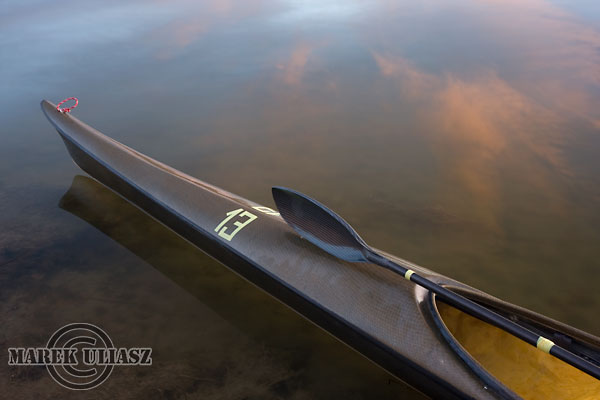
    Should I remove the number “13” from my kayak deck? I put it there before the Kansas River “Fitty Gritty” race in June. It is just a yellow electric tape, but, maybe, it adds some character to my kayak?

    paddling in Colorado

    6.

    What about breaking the Rule of Thirds and place the horizon exactly in the middle of the frame? This usually results in a more static and calm composition. The photo tips for beginners usually warn you not to do it.

    Well, I just like shooting those static, symmetrical pictures, but rather in a horizontal format. However, I needed the vertical format here to show both clouds and their reflections in the lake.
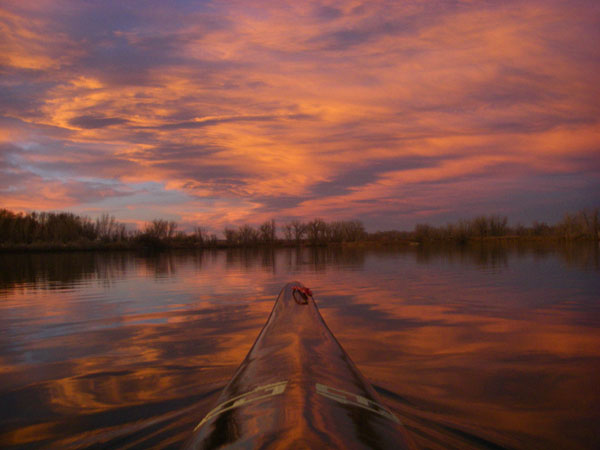
    I believe that the kayak bow adds some dynamics to the scene.

    It would be interesting to shoot the same scene at higher kayak speed with more of a bow wake. I would rather mount the camera on the kayak deck for this purpose and shoot in the interval mode. I have not tried the vertical format with the deck mounted camera yet.

    paddling in Colorado

    7.

    Sometimes, we just don’t need the horizon in the picture frame at all. The water provides enough interest.

    But, that was another paddling evening with another kayak – Sisson Nucleus. It is interesting that the white hull of Sisson and the black hull of Thunderbolt kayak look the same after sunset. They both work as a reflective mirror.

    Please let me know if you find this type of blog posts useful. I can certainly write more comments about my paddling pictures.

    And, please provide comments for specific pictures discussed here, especially, if your interpretation or suggestions for improvements differs from mine.

    Related posts and links:
  • Lake Superior: Journeys on an Inland Sea by Gary and Joannie McGuffin

    Lake Superior: Journeys on an Inland Sea by Gary and Joannie McGuffin

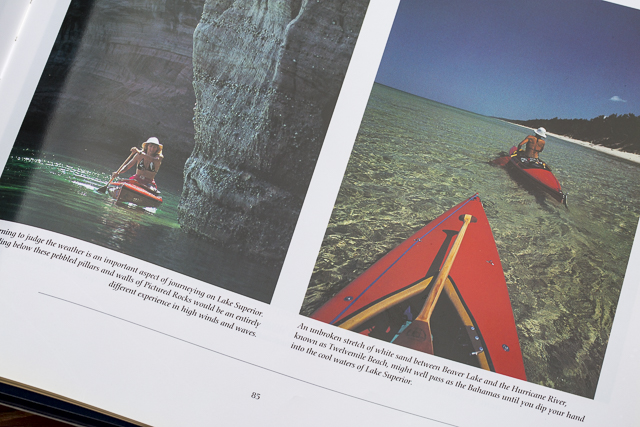
    There are several books which have influenced my paddling and photography. One of them is definitely Superior: Journeys on an Inland Sea, a wonderful coffee table book by a Canadian couple, Gary and Joanie McGuffin, full of great pictures from their kayak and canoe trips on Lake Superior.

    I believe that most of the pictures including a paddler (i.e., Joannie) were carefully staged, but they are still impressive. I am not aware of many photography books published by paddlers. Only Joel W Rogers comes to my mind.

    This in an old book. I bought it probably 20 years ago. Nowadays, you can buy used in a good condition for a few dollars. Originally, I posted this review in December of 2004.

    After getting this book I started to plan my own paddling trip on Lake Superior. It hasn’t happened yet with an exemption of a very short exploration of sea caves near Bayfield when driving back from Michigan and another short car visit in the same area. However, the book has had significant impact on my paddling.

    Lake Superior book

    I was intrigued by weird looking kayak-canoes used by McGuffins. After some research I learned about Verlen Kruger and his expedition canoes. McGuffins paddled his Monarch canoes. As a long time kayaker I wasn’t immediately convinced by Kruger’s designs, but after reading about some other long distance expeditions and e-mail exchange with Norm Miller I became a happy owner of Sea Wind canoe #127 in the summer of 2001.

    The McGuffins published several other books including Paddle Your Own Canoe, Where Rivers Run: A 6,000-Mile Exploration of Canada by Canoe, In the Footsteps of Grey Owl, Canoeing the Great Lakes Heritage Coast devoted to the 2003 expedition is also worth visiting. Again, a lot of wonderful pictures including impressive panoramas. It was example of a modern expedition combining a home built strip canoe with a high technology equipment – digital cameras, laptop and satellite communication to send updates from the trip. They also produce Wilderness Paddling calendar. It is worth to visit their web page.