Tag: video

  • Train or Relax with my POV video – paddling, rowing, biking

    Train or Relax with my POV video – paddling, rowing, biking

    Over the past year, I’ve been recording POV (point-of-view) footage from my outdoor adventures – mostly paddling, rowing, and biking. These videos offer a first-person view of real workouts in some of the most scenic areas of northern Colorado.

    So far, I’ve filmed in places like: Boyd Lake, Carter Lake, Horsetooth Reservoir, and Boedecker Reservoir and bike trails around Fort Collins, Loveland, and Windsor.

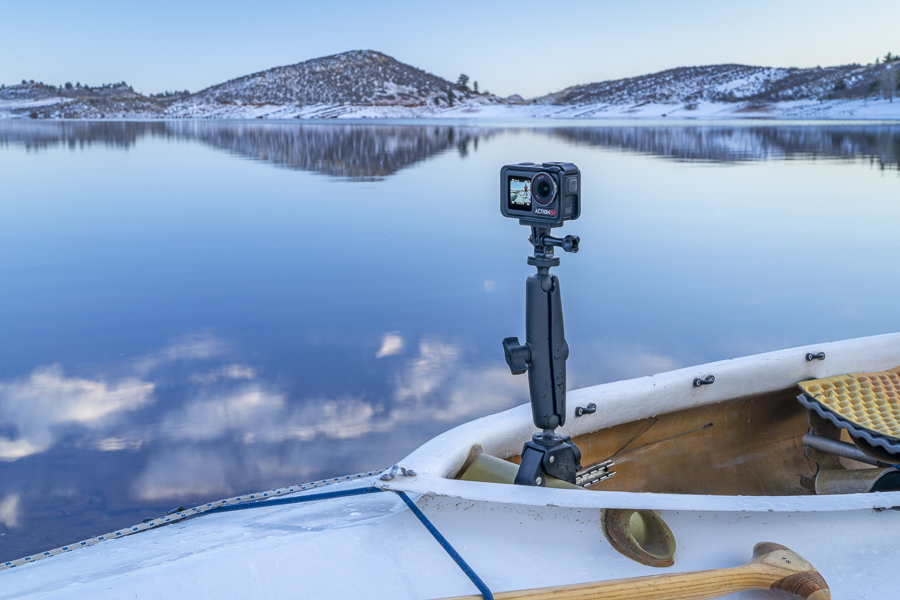
    I use a DJI Action 5 camera mounted with RAM mounts – on my bike’s handlebar, inside the cockpit of my Sea Wind canoe, or just above the mirror on my Liteboat rowing shell. Occasionally, I test other setups using SeaSucker or Neewer suction mounts to capture new angles. In the past I used GoPro cameras. Sometimes, I am using Sony RX0 II camera, but mostly for still images or static video, especially, with a partially submerged camera.

    • GoPro Hero 10 action camera mounted  on a paddleboard

    These recordings have evolved into four categories of video content, shared on YouTube and Kinomap:


    1. Outdoor Scenery for Indoor Workouts

    If you enjoy the idea of “training through nature,” this playlist might be for you. These longer videos (up to 1 hour) feature real paddling, rowing or biking sessions with ambient sounds (paddling/rowing), some text commentary and music from Epidemic Sound. Ideal for indoor rowing, cycling, or just watching to feel immersed in nature.


    2. Virtual Training with GPS and Heart Rate (on Kinomap)

    These are interactive, data-driven training videos for use with rowing, cycling, or running machines. Each session includes GPS tracks and HRM (heart rate monitor) data, synced with the video in real time. No music – just the natural sound of the activity and terrain.


    3. 10 Minutes of Relaxation (YouTube Series)

    My newest video series is designed for quick, calming breaks. These 10-minute POV videos combine real paddling or rowing footage with the soothing sound of the paddle or oars, gentle ambient music, and peaceful scenery. Great for stress relief, quiet focus, or simply unwinding.


    4. Inspirational Shorts for Aging Athletes

    I also create short 2–4 minute videos exploring themes like realistic optimism, resilience, self-forgiveness, and movement as medicine—all from the perspective of an aging athlete and active senior. These include paddling or biking footage, reflective narration, and motivational ideas.


    My most recent paddling footage comes from training sessions for the Missouri River 340 (MR340) – a 340-mile nonstop endurance race I’ll be paddling this July. It’s a major challenge and a key part of my training and motivation this year.

    If you’re using any of these videos for your indoor workouts, mental breaks, or just to connect with nature from home, I’d love to hear about it! Feel free to leave a comment or message me directly.

    Thanks for following along in this journey.
  • Paddling stories with my real voice vs AI voiceover

    Paddling stories with my real voice vs AI voiceover

    In my latest YouTube video, I’m trying something different – and I’d love your input.

    For years, I’ve used my own voice in videos where I share stories from my paddling, rowing, biking, and endurance races like the Missouri River 340. However, even after 36 years in the U.S., my accent is still strong — and it’s part of who I am. It adds authenticity and a personal connection. Some of my videos also use just ambient sounds, text, and music to tell the story.

    Recently, though, I experimented with something new: using an AI-generated voiceover.

    I chose “Sean,” a calm and clear British voice from Epidemic Sound. The result was smooth and professional — maybe more polished than my own recordings. But it made me wonder: does that polish come at the cost of personality?

    After publishing that AI-narrated video, one viewer left a comment that stuck with me:

    I believe your own voice has much more character than the AI voice. I heard you speak in an older kettlebell video and your accent is wonderful.

    That gave me an idea: why not ask my viewers directly?

    So in this new video, I present two versions of the same clip — one in my own voice, and one with Sean’s AI narration. There’s even a playful moment where we both try to introduce ourselves. (Spoiler: only one of us can pronounce “Marek Uliasz” correctly.)

    This isn’t just a technical experiment — it’s about connection. Some videos are personal, with me talking to the camera. Others are quiet, reflective, faceless shots from the water. Maybe different voices are better suited to different moods.

    Now I’d love to hear what you think.
    Watch the video, compare the two voices, and let me know: Should I keep using my voice? Use AI? Or blend both? Thank you for your input.

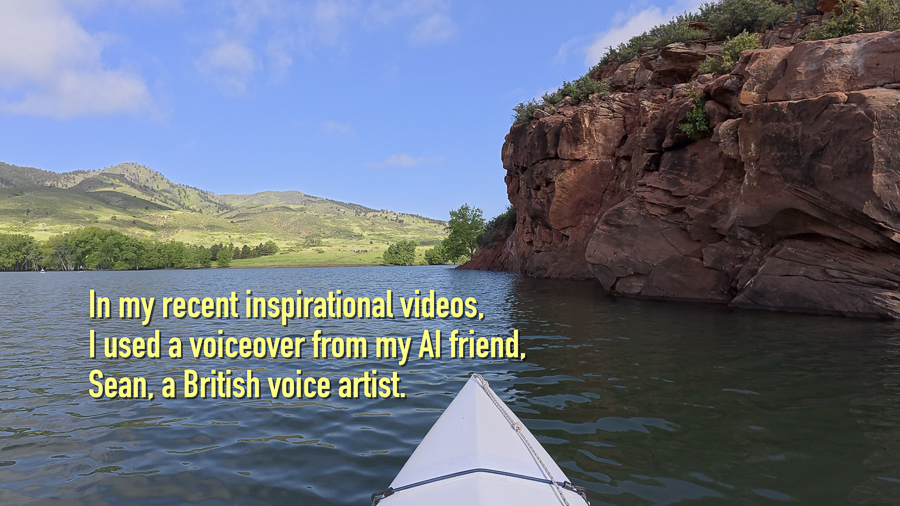
    Also, I’ve included a few frames from the video below.

    Recent videos on my FitOver67 channel using AI voiceover:

  • A Girl Who Loves to Run – Laura’s Story by Chase Jarvis

    Chase Jarvis blog is one of several photoblogs I read. I am under influence of his POV (point-of-view) photography. I haven’t tried anything like that with a bike yet, but I started to play with a Bogen – Manfrotto Magic Armand Super Clampon my surfrigger canoe.

    Here is Laura’s Story by Chase Jarvis. A video clip about a girl who loves to run. A simple narration combined with video and still pictures. Different and interesting shooting angles.

    It would be nice to create something similar about a paddler.


  • Kayak Video Camera Mast – Sticky Pod Combined with Monopod

    As many other paddlers I was inspired by a video camera setup used by Justine Curgenven in her This Is The Sea DVD series. So, last year, I started to experiment with my own mast for kayak photography and video. My idea was to combine the sticky pod suction cup camera mount with a telescoping 50′ monopod. However, I did not want to make any permanent modifications to my rather expensive, 6 segment Carbon Fiber Traveler Monopod by Gitzo. It is just another job for my Gitzo.

    This is “my sticky pod” – a camera mount with 3 suction cups. It comes with a mounting 3/8″ bolt. My Gitzo monopod and photo tripod heads have 1/4″ sockets, so I drilled an extra hole and I added 1/4″ bolt. The first thing I added was a tether!

    Note that the original bolts and rivets are getting a little bit rusty. It would be nice to have stainless hardware for a wet environment. The triangular base is made of aluminum.


    I removed a head from my Gitzo monopod and screwed it upside down to the sticky pod. You can use any monopod, just be sure that is has 3/8″ or 1/4″ socket. Aluminum monopods are not very expensive, starting around $20.

    Now, we need to attach a camera to the other side (i.e., normally bottom) of the monopod. As a temporary solution I used a small toy tripod with flexible legs and some plastic wraps. I believe I got that tripod together with a memory card order.

    Here is my camera, Pentax Optio W30, mounted on the mast. Don’t forget a tether!

    I added a temporary lens hood a year ago. It’s ugly, but it works protecting the lens against direct sun and water splashes.

    Flexible legs of the little tripod allow me to adjust camera position. I can shoot in both landscape and portrait mode. It’s not very robust solution however. For rough conditions I would use more solid mount to prevent camera movement or just more plastic wraps or even a duct tape.

    The camera mast mounted on the stern deck of my Thunderbolt-X kayak. It is almost fully extended and even with a light Pentax Optio camera affects stability of my tippy kayak. A few inches lower and the kayak behaves much better.

    One example of picture shot from the back deck with a fully extended mast – paddling Thunderbolt kayak on Beaver Pond near Fort Collins. Pentax Optio W30 was set in an interval mode and was shooting pictures every 10 seconds. I was shooting with a similar camera setup last year on the Horsetooth Reservoir, but the camera was mounted much closer to a paddler.

    It is a little bit tricky to set up a camera at that tall mast without looking at a LCD monitor. Perhaps, a small mirror would be helpful.


  • This Is the Sea 4 by Justine Curgenven

    Queen Charlotte Islands, Norway, Israel, Baja California, Lake Superior, The Bass Strait, The Ottawa River, New Zealand.

    Featuring 3 fascinating expedition stories Haida culture & humpback whales around British Columbia s Queen Charlotte islands; island hopping from Australia to Tasmania across the Bass Strait; & a 2400km trip around the stunning South island of New Zealand complete with intimidating surf & a helicopter evacuation. Rough water rolling, Greenland rope gymnastics & commando kayaking with DUBSIDE, Kayak fishing in San Diego, Rock hopping in Baja, kayak games with father and son in Norways stunning fjords, paddling the Dead Sea in Israel, Seakayaking the Grade 4 Ottawa River, Lake Superiors Apostle islands, and more …

    This is something I would like to get as a Christmas gift. I bought all three previous movies from the “TITS” series by Justine Curgenven and I am returning to the them quite often. I am watching not only sea kayaking in great presentation, but I am exploring how these videos were shot and what can I implement into my own attempts in making paddling movies.

  • Flip Ultra Camcorder + Waterproof Case = Video Camera for Paddlers? Part 1

    Flip Ultra Camcorder

    The Flip family consists of three simple, inexpensive, pocket camcorders: the original Flip Video, Flip Ultra and Flip Mino in several color mutations.

    These are popular gadgets and you can find reviews and a lot of information on the web. Here is CNET editors’ review of Flip Ultra:

    At the time of this writing, the best selling camcorder at Amazon.com isn’t a model from Sony, Canon, or Panasonic. It happens to be the Flip Video Ultra, the third iteration of Pure Digital Technologies’ simple plug-and-play video camera that features a hideaway USB connector and built-in software that makes viewing and sharing your videos incredibly easy. That may be a little surprising to some, but the fact is that cheap sells–the Ultra starts at $149. And when you combine cheap with easy, you can see why the Flip and its RCA relative, the RCA Small Wonder EZ201, are finding success in the marketplace.
    The bottom line:
    With improved video quality, a slightly trimmer design, and upgraded software package, the Flip Video Ultra is becoming a force to be reckoned with in the emerging low-end digital camcorder category.


    Flip Ultra Waterproof Case

    Flip Ultra Waterproof Case

    Flip Ultra is the model interesting for paddlers because you can get a waterproof case for it just for $30 or so. Waterproof cases for Canon point-and-shoot cameras are almost 10 times more expensive. Of course, you don’t have so many control buttons in Flip camcorders.

    Unfortunately, there is no tripod socket on this waterproof (there is one on a camera) case which limits paddling applications of the Flip from my perspective. I like to shoot movies with a camera mounted on a kayak deck or use it as a helmet cam. There are at least three solutions to this problem.
    pentax optio w10 as helmet cam

    1. You can get creative with some foam, bungees and/or duct tape as I did when transforming my Pentax Optio W10 into a helmet cam.
    2. It is not so difficult to add a standard 1/4″ tripod socket to the waterproof case. I’ve found the simplest do-it-yourself approach at PopPhoto.com. I am not sure how strong it is. If you are going to paddle through rapids or waves with your camera mounted on a bow you may considered a more solid design.
    3. Finally, I’ve got a prototype of a “flip grip” together with the Flip Ultra in a waterproof cases from WetStuff.com for testing. It is a neoprene pouch designed for carrying the camera on your chest. I used it for some paddling and inline skating including comparison with a video from my Pentax Optio W30. I am also trying to mount it on the sticky pod suction cup. I will post my comments and some movie examples in the next part (or maybe even parts) of this article.

    If you would like to buy Flip Ultra or check other models (Mino looks interesting for dry environment) you are welcome to use my amazon.com affiliate links – just click on pictures.

    If you are using Flip Ultra please write some comment about your experience, especially, if you had a chance to compare it to other cameras. The comparison with GoPro Hero or Oregon Scientific video recorder would be really useful.

  • Bent Shaft Paddle and Outrigger Canoe

    These two pictures of Surfrigger, my outrigger canoe, were shot about a month ago on Beaver Pond near Fort Collins. I used my “big” camera, Canon EOS 40D, with EF-s 17-55mm lens mounted on a tripod.

    It turned out to be sort of a still life study with my paddle resting on a canoe bow. It was calm without any wind, but I still had troubles to keep that long (24′) and light boat still on water for photography.

    Surfrigger featured in two of my old video clips: Surfrigger I made in winter on the Beaver Pond, and Surfrigger II from Boyd Lake and Horsetooth Reservoir paddling. Both movies were shot with Canon PowerShot S40 in a waterproof case. It was time before my first waterproof Pentax Optio.

    The Surfrigger pictures are available for licensing as royalty free from Featurepics.com. You can read more about microstock photography in Pixels Away blog.

  • Use Your Paddle to Stabilize a Camera

    stabilize camera on paddleI often use a paddle to stabilize my Pentax Optio camera, especially, when paddling rather tippy boat like Sisson Nucleus or Spencer X-treme. It serves two functions:

    1. To have your paddle ready for bracing.

    2. To avoid shaking the camera when pressing a shutter button.

    I recommend this technique for shooting with any small camera, just keep your camera on a leash and attach a piece of non-slippery material to your paddle. I also recommend to use a 2 second self timer whenever possible and reasonable.

    Of course, this method may not work if you are paddling against 30 knot wind or through rapids …


    paddling & shooting

    I was caught on video by Marcie Nolan when shooting with my Pentax Optio W10 from Sisson Nucleus kayak during warm-up before the recent Dotsero Race on the Colorado River in Glenwood Canyon.