Author: Marek

  • Winter Paddling with Sea Wind Canoe on Horsetooth Reservoir

    Winter Paddling with Sea Wind Canoe on Horsetooth Reservoir

    winter canoe paddling in Colorado

    8 years ago, end of March, 2005 …

    Sea Wind canoe was featuring in a movie clip from paddling on the Horsetooth Reservoir in a winter scenery.

    I launched from Lory State Park at North Eltuck Cove and paddled south to Orchard Cove and back. Launching was fun since I didn’t have to carry the boat to the water. Water Abstracts come from the same paddling trip.


    I used Canon Optura XI camcorder mounted on a regular tripod on land and on mini tripod in the front of Sea Wind.

    I visited the Orchard Cove a few day later. It wasn’t that nice without snow. When the reservoir was drained during recent years most of cottonwood trees along the shores died. There were cut down and only stumps and piles of wood scraps remained. I remember paddling beyond these trees years ago when the reservoir was full.

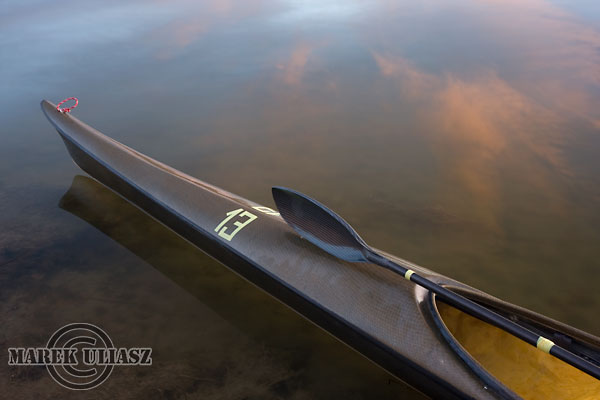
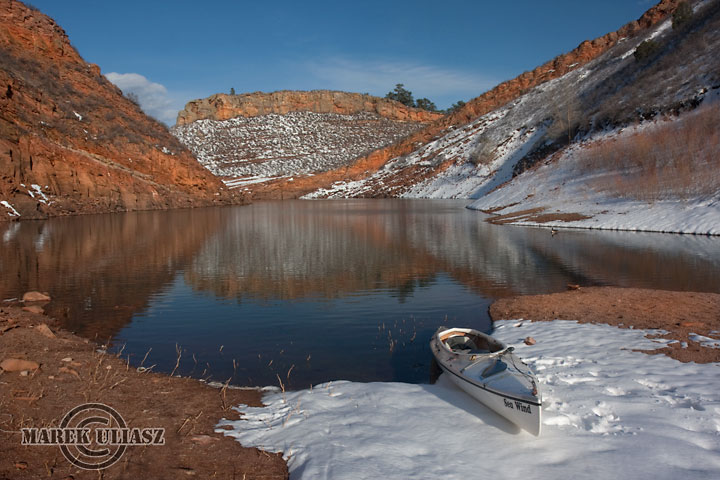
    The opening picture in this post, Sea Wind canoe in Quarry Cove of Horsetooth Reservoir, was shot on March 28, 2009 with Canon 40D on a tripod. It is one of Horsetooth pictures in my stock photography portfolio available for purchase and licensing.

    Related posts:
    Thunderbolt Racing Kayak and Ice in Early Spring Paddling
    Icy Horsetooth Reservoir – Opening Lake Paddling Season
    Paddling Horsetooth Reservoir in Winter Scenery

  • Thunderbolt Racing Kayak and Ice in Early Spring Paddling

    Thunderbolt Racing Kayak and Ice in Early Spring Paddling

    I am reviewing my old forgotten paddling video clips and posting them to my YouTube channel. Here is one from March of 2007. First paddling that season with Thunderbolt-X kayak on Beaver Pond in Arapaho Bend Natural Area. I was just playing in a small area of free water and pushing the kayak through a soft ice.

    I bought Thunderbolt designed and built by Doug Bushnell from West Side Boat Shop in December of 2006. You can find a lot of pictures of Tbolt, trip and race reports in this blog and in Fitness Paddling.

    Camera: Pentax Optio W10 mounted on a front or stern deck with the single suction cup sticky pod>/a>, no extensions.

  • 10 Tips How to Avoid Blurry Pictures when Shooting from a Kayak

    Compact waterproof digital cameras like Pentax (Ricoh) Optio WG-series or Olympus Tough series are popular among paddlers. They may not offer the highest image quality among point-and-shoot cameras, but they still produce decent pictures. Most importantly, you can photograph in conditions where other cameras are better kept in a dry case or box.

    However, new camera owners are often getting pretty bad, blurry pictures and are really disappointed with a purchase. Shooting on water from a kayak or canoe requires some extra efforts and practice from a paddling photographer. Here are a few tips which may help. This is an update of my old post written 5 years ago. Cameras are getting better, but, I believe, the tips below are still valid. I have been using Pentax Optio waterproof cameras starting from the original model WP, then W10, W30, and, currently, WG2 is attached to my life jacket.

    1. Use the automatic mode

    I do not have any special settings for my camera. On water I use exclusively the P (program) mode. Of course, in addition to the P mode I use the movie mode and interval drive mode quite often.

    You can program the green button to do useful adjustments without a need to go through a setup menu. I am using two functions assigned to the green button: exposure correction and, much less often, white balance setups. Typically, I underexpose my shots to avoid overexposed areas with wash out details. Coincidentally, it shortens the exposure time which helps to avoid blurry pictures, but this is not a main purpose of this adjustment.

    2. Keep the camera steady

    This is the most important tip. However, it is not so easy when paddling, especially, when water is not calm. Ideally, you should hold the camera in both hands. In addition, it is quite easy to shake the light and small camera just by pressing a shutter button.

    3. Use a paddle shaft to stabilize the camera

    Here is a short video clip demonstrating how I am doing it.

    This technique really helped me when I was starting to paddle a tippy Sisson Nucleus kayak. You can achieve two goals: to stabilize the camera and to stabilize your kayak. You have your paddle ready for bracing. This technique does not work with strong, gusty winds.

    You can go further with this idea and attach or mount your the camera more permanently to your paddle – see a camera cradle by Mark Sanders.

    4. Use a self timer

    The 2 second selftimer available in Pentax Optio is very useful to avoid shaking the camera when pressing the shutter button. I recommend it, especially, when you are holding the camera with one hand (shooting on an extended arm or from some unusual angles).

    5. Keep your lens clean of condensation, water drops, water residue

    I keep my camera in a small neoprene pouch attached to my life jacket and usually do not have problems with water or dirt on my lens. The camera is always on a tether. Shooting with a camera mounted on a deck and exposed to splashes is another story.

    6. Pay attention to light and sun position

    Try to shade you camera lens from a direct sunlight to avoid a lens flare. Do not shoot against the sun.

    It is possible, at least for Pentax, to glue (epoxy) some step-up rings and to attach lens hood to your camera. I am using much simpler solution: an improvised lens hood attached with an electric tape to the camera.

    You can expect the best “sweet” light for shooting when the sun is low, so after the sunrise and before sunset. Do not expect too much from this camera in low light conditions, but do not give up with shooting as soon as the sun is down. Consider shooting some silhouettes or water reflections then.

    7. Use flash

    Sometimes, I use flash to add light to objects in my fore plan. Usually, a soft flash option works better for a kayak deck. Be aware of any reflective tape on your kayak or gear.

    8. Shoot multiple frames

    Don’t limit yourself to a single shot for a given scene. Repeat the shot. Try different angles, horizontal and vertical format. You will increase your chances to get that great shot. Digital memory is cheap. You can always erase unsuccessful pictures later.

    9. Photoshop …

    Downloading pictures from the camera to your computer is not the end of your work as a photographer.
    Use Photoshop or other image editing software to post process your pictures. Most often, I rotate my pictures to make horizon horizontal, adjust the exposure with levels, crop and resize them, and, finally, apply some sharpening. You cannot save completely blurred pictures in Photoshop, but you can improve most of them.

    10. Practise

    There are no reasons not to take and use the camera wherever you go. It is small and waterproof. Experiment and have fun.

    Time to to time it is useful to browse through the camera manual. You may find something new and exciting in a jungle of all these options and settings.

    More tips?

    Could you share tips from your experience with a kayak or canoe photography? Are your on water pictures worse than these shot on land?
  • 8 Years Ago: First Impressions of New Waterproof Camera – Pentax Optio WP

    Pentax Optio W cameras

    In April of 2005 I bought my first digital waterproof camera – Pentax Optio WP. It was pretty unique little camera at that time which really changed my paddling photography and blogging. Since then, I have upgraded through several models of Pentax Optio as seen on the picture above.

    Currently, I am using Pentax Optio WG-2. You can already buy a newer version, Pentax Optio WG-3, and several other similar waterproof cameras from other manufactures. Pentax Optio, whatever version, stays always attached to my life jacket and ready to use.

    Here is what I wrote 8 years ago …


    pentax optio wp
    April 26, 2005
    Canon PowerShot S40 with or without waterproof case has been my main paddling companion. Most pictures on my paddling website are produced by that 3 year old camera. Occasionally, I am also using my digital SLR camera Canon 10D, e.g., in my solo paddler, solo photographer series.

    However, I was thinking about a camera I could take to Texas Water Safari. It would need to be small and waterproof. The Canon PowerShot in the waterproof case would be too heavy, too bulky and too awkward to operate for a tired racer at the edge of hallucination. I am ready to add no more than a weight of one or two power bars to my racing setup. A tiny and waterproof Pentax Optio WP provides some hope here.

    It is waterproof! The camera has survived a first shooting in a rain during my Big Thompson River paddling and a 15 minute photo session in a glass of water.

    It is small, compact, and it looks pretty solid without any protruding parts. A zoom lens is always inside a waterproof case behind the protective glass. The small size has, however, some downsizes. A grip is much less secure than with my larger Canon PowerShot. It is difficult to operate zoom control when holding the camera in a one hand. I had problems to get sharp pictures when shooting with one hand from my tippy Sisson kayak. No problems when both hands are available for photography.

    The camera turns on very quickly just with a touch of a button. No need to uncover lens and wait for zoom lens to extend as in my Canon PowerShot.

    There is no viewfinder, just an LCD display. It is difficult or impossible to read it in a direct full sun. However, I am ready to accept that compromise in a digital camera, where I can always review the picture and/or histogram after a shot.

    As a somewhat advanced photographer I like to have more control over camera operations that it is possible in the most of “idiotproof” point-and-shoot cameras. So, it is easy for me to point out what I am missing in Pentax Optio.

    Typically, I am shooting my paddling pictures in Av (aperture priority) mode. The aperture (depth of field) is set to a maximum value and the camera automatically selects the exposure time. If the exposure time is too long for a handheld shooting I am adjusting aperture or, as a last resort, sensor ISO speed. There is no Av (or Tv) mode in Optio. Instead, there are numerous (20 or so) automatic shooting modes from landscape, to portrait, to food or museum. I guess it’s not much different than in other similar point-and-shoot cameras.

    I am taking advantage of locking the exposure setting (AE lock) In my Canon cameras – locking the exposure on the specific subject and the recomposing the image. I’ve found that feature extremely useful in my paddling photography. It can be used only in Av or Tv mode, so it’s not available in Optio. There is a exposure compensation in Optio. However, I’ve rarely used it in my Canon cameras. I just prefer to check different parts of my scene with the AE lock until the exposure of the entire picture looks OK. I will need to change my shooting habits … All pictures made with Pentax Optio during my Big Thompson River paddling were shot in the basic picture taking mode – P.

    canoe paddling canoe paddling paddling Colorado

    Judging from my recent paddling on Big Thompson River and Beaver Pond, the camera is not only waterproof but also attracts a wet weather …

    Anyway, Pentax Optio looks promising for my paddling and racing needs. I am going to post next comments after more paddling and shooting in different conditions and after some more systematic exploration of the camera features. The ultimate test for the camera will be the next Texas Water Safari. The Pentax Optio needs not only to survive the race but also to produce a good photo story!


    Pentax Optio WP did really well in 2005 Texas Water Safari and, next, in other ultra marathon paddling races.

    Related posts:
    10 Tips How to Avoid Blurry Pictures when Shooting from a Kayak

  • Suction Cup Mounts on Inflatable Badfish SUP ?

    Suction Cup Mounts on Inflatable Badfish SUP ?

    I am using suction cups on all my kayaks and canoes to mount cameras and GPS devices. Of course, you need a smooth surface to attach a suction cup. Rinsing the deck of your boat with water usually provides a stronger grip. But, what to do with decks which are not smooth like in the case of inflatable boats?

    suction cup mount on inflatable SUP

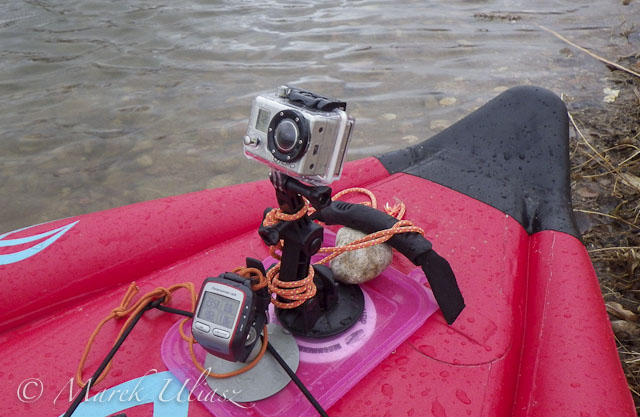
    I faced that problem during my first paddling this season on Beaver Pond with Badfish inflatable SUP (stand up paddleboard). Here is my quick and temporary solution: a lid of plastic box tacked under bungees and a handle in the front deck of my SUP. It provided just enough smooth surface to place my Garmin Forerunner GPS on sticky pod suction cup and GoPro Hero camera on its original suction cup mount. My suction cup dashboard worked pretty well for quiet water paddling.

    As a more permanent setup, I would probably use more a solid plate (plexiglass?) with holes to tie it to available anchor points. Do you have any other suggestions or ideas?

    Badfish SUP on Beaver Pond
    Badfish SUP - March paddlingIt was rather cold and cloudy day …

    Badfish SUPwhich ended up with some snow.

    Galena wildfire smoke plumeTwo days later (March 15, 2013). Paddling Badfish SUP on Beaver Pond in Arapaho Bend Natural Area with a smoke plume from Galena wildfire behind me.
    Related posts and links:
    MCIT 11.6′ Inflatable SUP Badfish at Colorado Kayak Supply
    Sticky Pod Camera Mounts
    GoPro HD HERO3 camera (I am still using GoPro Hero 2)
    10 Minute Double Suction Cup Camera Mount for a Kayak Deck
    Kayak Video Camera Mast – Sticky Pod Combined with Monopod
    A Simple Suction Cup Mount for Garmin Forerunner 305 GPS
    Sticky Pod Review – Suction Cup Camera Mounts for Kayak Photography

  • South Platte River at Fort Lupton – Northern Colorado Paddling

    South Platte River at Fort Lupton – Northern Colorado Paddling

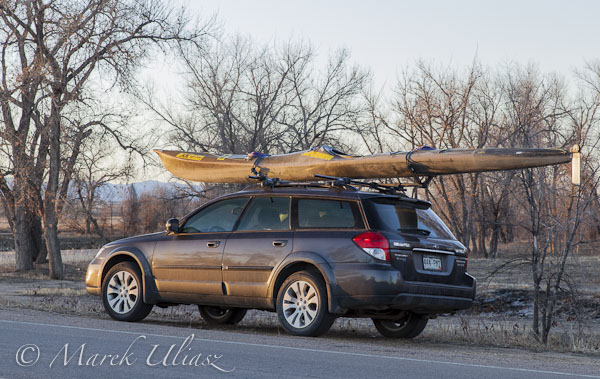
    Subaru Outback and JKK Supernova kayak
    I haven’t paddled my JKK Supernova kayak since 2012 Missouri River 340 race. I decided that to rinse some Missouri mud off.

    paddling South Platte River with GoPro camera

    Paddling upstream with GoPro camera mounted in the front deck.

    paddling South Platte River

    About 2 miles upstream of Fort Lupton. The river was shallow, fast, twisty, stinky … Near perfect! I had a great workout.

    South Platte River at Fort Lupton
    Back to Fort Lupton.

    I have paddled JKK Supernova starting at Fort Lupton several times this winter. It seems that my driving time from Fort Collins is about 45 minutes and is not longer than driving to Kersey below Greeley. I didn’t try to paddle my SUP since some spots were too shallow for a fin.


    This is a diversion dam just below Fort Lupton. I’ve paddled the river between Fort Lupton and the confluence wit St Vrain Creek. There are 7 dams in this short section. Maybe, it’s a time to run it just for documentary purposes, certainly, not for recreation. It feels like a packrafting project.

    Related posts:
    South Platte River below Denver, Colorado – GPS/photo river guide

  • Winter Walk Along the Poudre River in Fort Collins

    All my local paddling waters are covered by ice. Even the Horsetooth Reservoir is partially frozen as seen in this recent picture of the Inlet Bay. So, it’s time for more hiking, biking and inline skating or driving to the South Platte River which is open and flowing.

    Here is a little gallery of pictures shot during winter time along the Cache la Poudre River in Fort Collins. They came from favorite natural areas, Arapaho Bend and Riverbend Ponds or just from the Poudre biking trail.

    Cache la Poudre River, Fort Collins winter river in Colorado
    winter road - Riverbend Ponds Natural Area Cache la Poudre River in winter
    rusty flume suspended over a river old rusty aqueduct across a river

    These images are available for licensing as royalty free digital downloads starting with $2 directly from my stock photography portfolio. Recently, I started to sort my Colorado portfolio into several galleries. It should not be surprising that three of them are related to water:


    Horsetooth

    Horsetooth

    Horsetooth Reservoir and Horsetooth Mountain Open Space near Fort Colorado – a great area for water sports, hiking, climbing, trail running, and mountain biking. It is my favorite local destination for kayak, canoe and SUP paddling.


    Cache la Poudre River

    Cache la Poudre River

    Pictures from the Poudre Canyon as well as pictures of the river as seen from biking trails in Fort Collins and downriver all the way to Greeley and confluence with the South Platte River.

    water

    Water

    Water issues mostly in Colorado – river diversion, irrigation, ditches, water pollution. Many pictures in this gallery are shot from a kayaker perspective.

    Related posts:
    Fort Collins and Northern Colorado Pictures in My Stock Photography Portfolio
    Fort Collins from Winter Hiking the Horsetooth Rock Trail
    Horsetooth Reservoir in Winter Scenery
    Riverbend Ponds in Late Fall Scenery
    Paddling the Poudre River at Nix Natural Area in Fort Collins

  • Stand Up Paddling the South Platte River below Denver

    Stand Up Paddling the South Platte River below Denver


    SUP on South Platte River

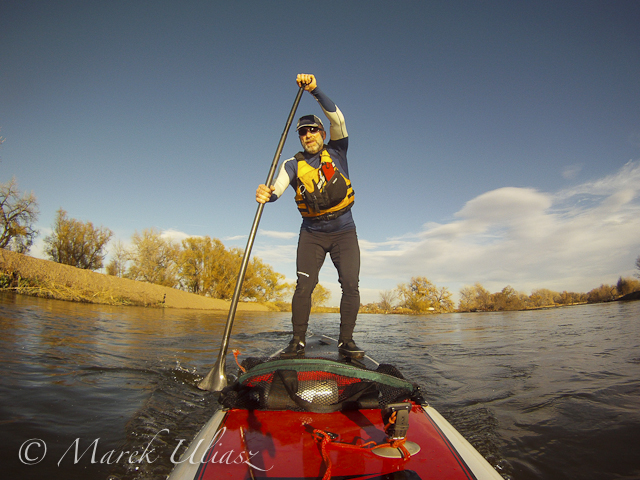
    November 3, 2012. Paddling Bark Expedition SUP on the South Platte River near Kersey, Colorado. Camera: GoPro Hero.

    It was my first time with SUP on a river – a short, but intense upstream / downstream workout starting at the Kersey bridge. A nice weather and good river flow. You can find more picture from that paddling in Fitness Paddling blog.

    I will be back on the South Platte with SUP or other boat. The winter paddling season is open.

    Related posts:
    SUP on the South Platte River – Opening Winter Paddling Season
    South Platte River below Denver, Colorado GPS/photo river guide
    Daily Paddling Picture Gallery