The Joint Club Paddle is scheduled for Saturday, March 25, with a snow/rain date set for Saturday, April 1st. It’s rescheduled to April 1! Rocky Mountain Canoe Club, Poudre Paddlers, High Country River Rafters, Flatwater Frogs, and Rocky Mountain Sea Kayak Club will be back on the South Platte River to start the 2023 padding season. You don’t need to be a member of any paddling club to participate.
The trip will start at Riverside Park in Evans and you can paddle 9 miles to Kersey or 15 miles to Kuner. This is an easy and fun trip for paddlers with any skill level. Typically, it’s more floating than paddling. You will see probably every possible kind of a paddling boat there. I am going to paddle one of my stand up paddleboards. If you are SUP paddler be prepared for a shallow river concerning your fin.
You can find all of details, cautions, and contingencies in the 18th Joint Club Paddleflier.
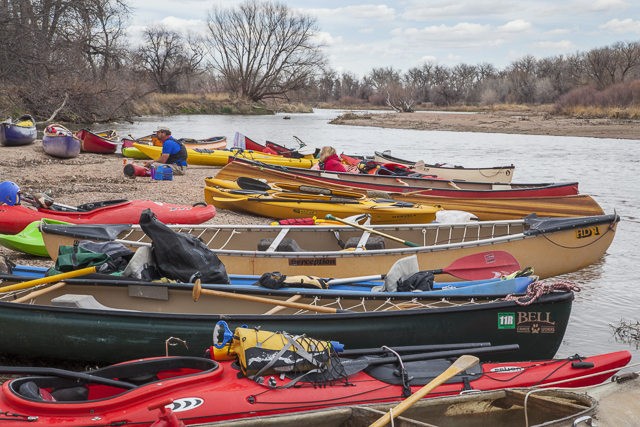
Some pictures from previous trips (in some years the trip was running from Brighton to Fort Lupton):
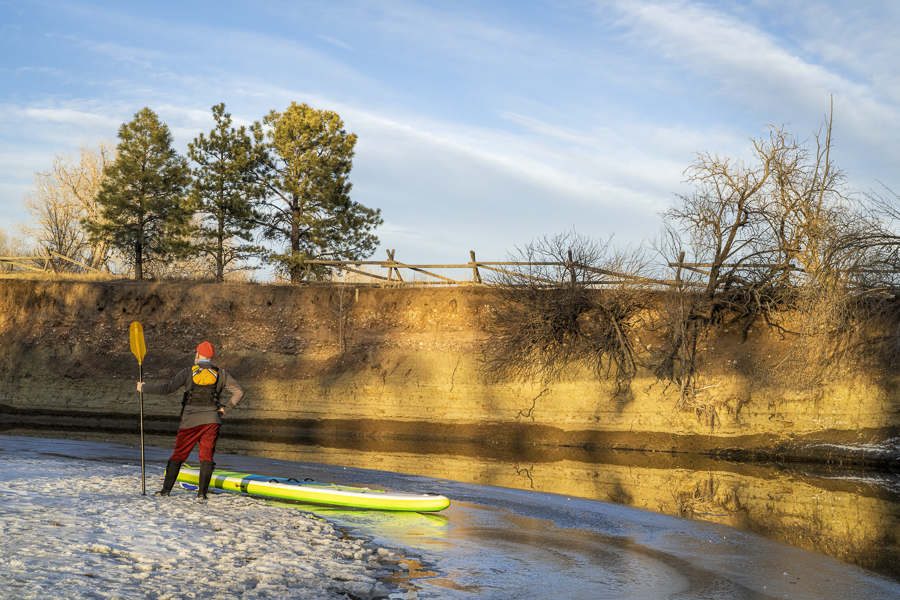
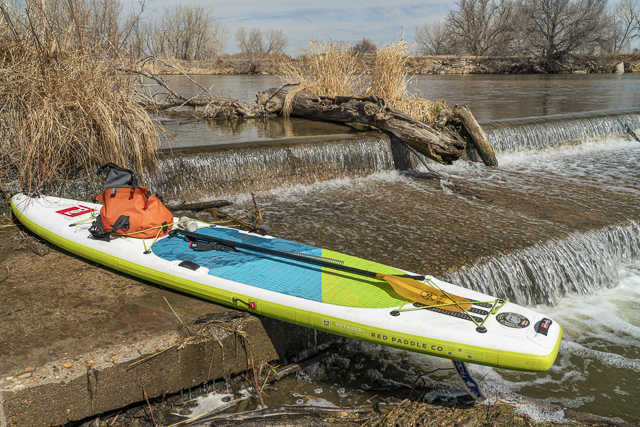
On February 17th, I began my 2023 river paddling season by taking my inflatable stand up paddleboard, the Voyager by Red Paddle Co, to the Poudre River in Fort Collins. The river flow in wintertime is close to zero, about 20 cfs, but you can find some water in the Poudre which will float you boat. Just look for backwaters of diversion dams: standing or slow moving water and very shallow. It’s not good for serious paddling, but it may be enough for some playing, shooting pictures or testing equipment.
I visited Poudre River section in Kingfisher Point Natural Area (access from Hoffman Mill Rd). In my old blog posts I may refer to this area as Nix or Nix Farm Natural Area. Depending on the river flow and operations of the diversion dam you may find there almost 1/4 of paddling water. If you are willing to do some dragging, you can even reach the Lemay street bridge at the upstream end.
The river is very shallow except very close to the dam. Therefore, you cannot use a regular long fin on your paddleboard. For recent 6 years, I’ve been using a retractable fin from Frogfish. I’ve found it on Amazon, but it doesn’t look to be available right now. Another solution is to use some sort of a flexible fin, like this one from saruSurf. You don’t really need a fin here, since you are paddling in circles anyway. However, the retractable fin is very useful for paddling down the South Platte River which is usually deep enough, but poses a high risk of hitting shallow areas or other underwater obstacles. So, if you are a SUP paddler be prepared for the joint paddling clubs trip on the South Platte, usually 3rd Saturday of March from Evans to Kersey or Kuner.
During my trip, I paddled more than 3 miles, going up and down the river and paddling in circles while shooting pictures and videos. I have some footage to edit and post on my Youtube channel. Please check my paddling playlist.
You can find another river spot like this in Fort Collins downtown at Legacy Park, but it’s more likely to be covered by ice in winter.
I am relatively new to stand up paddling (SUP). Relatively … I mean I’ve been paddling for more than 50 years, but I started SUPing just 10 years ago. In September of 2012 I got my first paddleboard: 14′ Bark Expedition. Later, I did some long distance river races on different paddleboards including Missouri River 340, shorter races on the Missouri River in South Dakota and Chattajack in Tennessee. Perhaps, I should post some comments on my 10 years experience with stand up paddling.
Meanwhile, I just added a short video to my fitover67 Youtube channel – sunrise and morning in Boyd Lake State Park featuring my old SIC X-14.0 paddleboard. I believe it is similar to the newer SIC Okeanos series.? These were actually 2 or 3 morning paddling sessions in August 2019. This year Boyd Lake is much lower and my favorite tree is gone.
Please visit my channel. I would greatly appreciate any comments. I am going to create more content like this combining video, still images, music and sounds recorded outdoors.
This year Annual Joint Club Paddle returned back to a traditional section of the South Platte River on March 26th. The trip started from the Riverside Park in Evans and eded up after 9 miles at Kersey or after 15 miles at Kuner. It was a nice weather and plenty of water for paddling at ~700 cfs flow at Kersey.
There were 3 stand up paddleboards this year. I paddled 13.2’x30″ Voyager by Red Paddle, inflatable touring SUP with a pivoting fin by Frogfish. I paddled with the main group to the first dam, and then went a little bit faster reaching Kuner after ~3.5 hours and 15.4 miles.
There were some changes on the river. Portages over dams were somewhat more difficult, especially, for larger groups. The group did a longer portage over the first dam on a left shore. I managed to do a short portage portage on the right. I wanted to be on the right shore for some photography.
Is it possible to paddle downriver from Kuner to Fort Morgan? Is it worth it?
My answer for both questions is yes.
10-20 years I was actively training for marathon paddle races including Texas Water Safari and WaterTribe events. It motivated me to paddle in winter and spring when lakes in northern Colorado were frozen. During that time I explored different sections of the South Platte River all the way to Fort Morgan and a little further to the Snyder bridge.
I still have some old pictures, stories and blog posts from this series of “paddling on wet sand”, probably, with many broken links. Sorry! At least, they can give some ideas what to expect.
There are numerous dams and a lot of water diversion. So, it is really necessary to check river flow data and plan accordingly. Sometimes, it may be wiser just to paddle the Evans to Kuner section with a more reliable flow. It’s better to plan shorter paddling sections or/and have some exit strategy if your paddling is going slower that expected. I paddled at flows as low as 100 cfs at Masters, but it required a lot of kayak dragging.
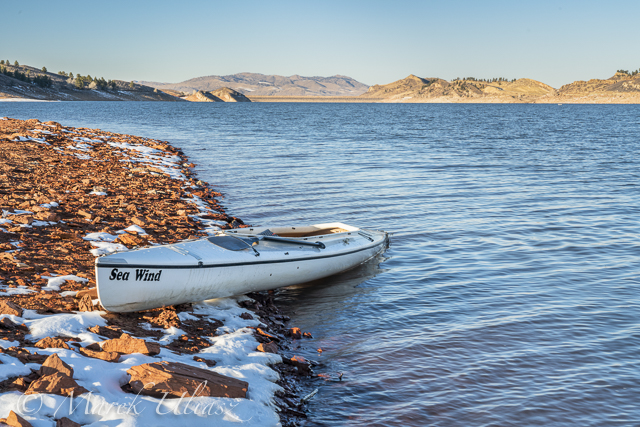
New Year Day afternoon. I started the 2021 paddling on Horsetooth Reservoir with Sea Wind, my expedition canoe. No drysuit or wetsuit needed, but loading this boat on Toyota 4Runner and carrying to water was a good crossfit training in comparison to paddleboards. It wasn’t a long trip, just 6 miles with a longer break for photography.
This boat is almost 20 years old. I bought my Sea Wind, #127, from Verlen Kruger in Michigan in 2001. Actually, it was the first canoe built by Mark Przedwojewski aka ManitouCruiser, then the new owner of Kruger Canoes. It’s all history now …
Horsetooth Reservoir is pretty low at 46% of its capacity. Last winter is was almost full. A very different scenery and paddling conditions. Water temperature is still 49F and no ice cover. See: current Horsetooth Reservoir conditions.
Satanka Cove at northern end of the lake is the best place to start paddling. I usually launch my boats just next to the Horsetooth Dam. It is steep, but the shortest walk to the water from a parking lot. At low water level, the boat ramp (closed) at Satanka Cove is very long. You can also launch from Lory State Park at Soldier or Eltuck Cove, but again it’s a very long walk under current conditions.
It looks like during last few years I was able to paddle Horsetooth Reservoir almost all winters. The effect of a global warming? I remember that 10-20 years ago I was doing most of my winter paddling and training on the South Platte River with an occasional trip to Lake Pueblo.
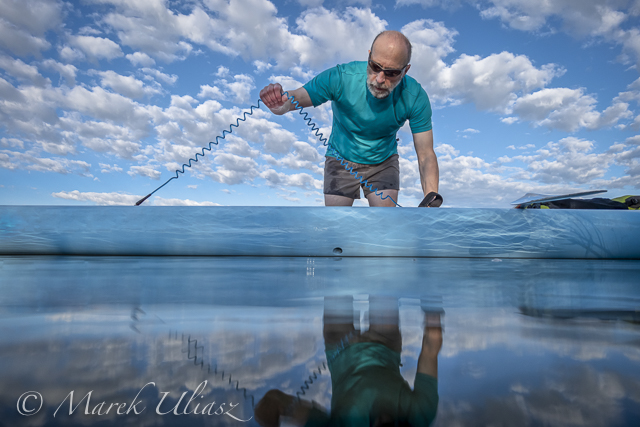
Paddling in blue: blue sky, blue paddleboard, blue paddler, blue leash … Happy accident or conscious color selection? I am not sure.
This picture in from my morning paddling in May on Beaver Pond in Arapaho Bend Natural Area, one of many natural areas in Fort Collins along the Poudre River. It was shot with Sony RX0-2 camera from a water level. The camera was probably partially submerged. This low angle gives very nice reflections, but the result is always quite unpredictable.
The paddleboard is not recognizable above, but it is 17.6’x24″ Mistral Stealth, my favorite board in 2020.
You can find more of my recent pictures from paddling on instagram, but I will try to share some stories here.
I love paddling on the Horsetooth Reservoir in cold season. Boat ramps are closed, no power boat traffic, usually quiet and calm. Snow and ice can enhance scenery. A great time to paddle, train, relax or photograph.
The Horsetooth stays ice free longer than Boyd Lake or smaller lakes in Fort Collins like Beaver Pond in Arapaho Bend Natural Area. South Bay freezes first, and than smaller coves. Don’t get discouraged by a webcam showing the South Bay. Very often you can still find open water in northern end of the reservoir at Satanka Cove.
In some years, I was able to paddle Horsetooth for the entire winter, in others till February. This winter season is somewhat unusual because water level is very high.
Earlier in a cold season I am using a wet suit, and later I am switching to supskin drysuit. I always paddle in life jacket and safety leash on paddleboards. I also carry the spot device for emergency, and always some sort of photo equipment.
This winter I am paddling mostly various stand up paddleboards and sometimes my expedition canoe.
Here are some pictures and comments from my paddling in 2019/2020 season. What is your experience from paddling Horsetooth Reservoir in winter? Any practical tips?
Horsetooth Reservoir in February 2020 as seen from a parking lot at Satanka Cove. A tip of that peninsula is a good place to launch when the cove is covered by ice. You can also take a shorter, but steeper walk towards the end of Horsetooth Dam.
A few time in late fall I launched my paddleboards from the Lory State Park at Soldier Cove. It’s a pretty short walk (~200 steps) to water protected from winds. Of course, later in winter is not an option. The picture above shows my last launch of 14’X26″ All Star by Starboard SUP there on January 12. It involved some walks around ice fields.
Occasionally, I am taking a walk between Satanka and North Eltuck Cove, just for fun and photography. Let’s call it cross training.
A thermos bottle with hot tea belongs to my standard equipment in winter paddling, since I often take longer breaks for photography. Usually, it happen close to sunset when it’s getting pretty chilly.
Experimenting with a low angle POV from a partially submerged action camera – Sony RX0 2. That camera has a narrower angle of view than GoPro and it doesn’t work so well as a bow camera on a 14′ paddleboard. A longer board needed!
Satanka Cove. First paddling in a snow blizzard. A great opportunity for photography.
Paddling along icy cliff in Sea Wind, a heavy duty expedition canoe designed and build by legendary Verlen Kruger. This boat is a great icebreaker, but it’s much easier and faster to load SUP on roof racks.
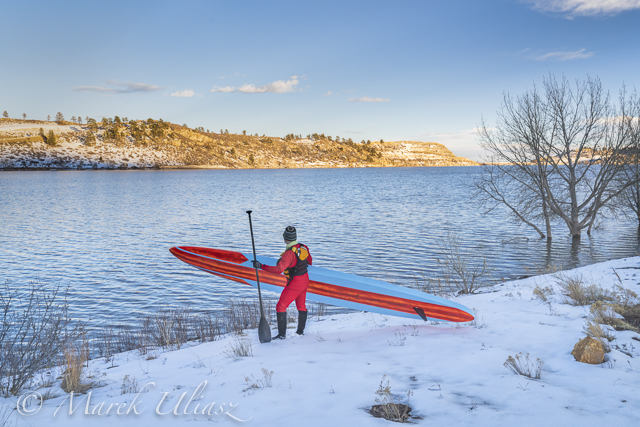
February 15. Northern part of the lake was still open. Trying a new board in icy conditions: 17.6’x24″ Mistral Interceptor. I needed something to much my Santa drysuit
The long, unlimited paddleboard (~35 lb) is more awkward to carry around than 14′ boards. And, even a safety leash attached makes it tail heavy.
This article was originally posted in May of 2009. Horizontal pictures usually work better on websites and on most of social media. There are exceptions, like Instagram where is better to post square or vertical images. Well, if you are shooting for a magazine cover is a different story.
Like most paddlers I have a tendency to shoot pictures in a horizontal (landscape) format. It is more tricky to shoot in a vertical format from my tippy kayaks, especially, when I have to use a paddle to stabilize my camera.
Some subjects simply require the vertical (portrait) format. Sometimes the choice is not so obvious. Of course, the best solution is to shoot several pictures in both formats.
I posted below a few couples of pictures shot from the same spot in both vertical and horizontal formats. In all situations the traditional horizontal format work pretty well. However, the vertical framing allows me to show better an interesting sky or something dramatic in a foreground. Older pictures (2007) were shot with Pentax Optio W10, while newer (2009) with Optio W30 camera.
Horizontal or vertical? Which image version do you prefer in each case?
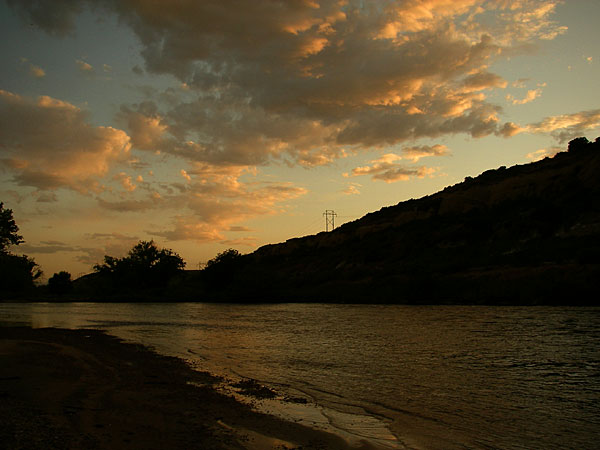
Sunset over the South Platte River at Wildcat Mound
below confluence with the St Vrain Creek. June 2007.
Sunset over the Horsetooth Reservoir near Fort Collins shot from Thunderbolt-x kayak. June 2007.
Calm evening with Sea Wind canoe on the Lonetree Reservoir near Loveland. May 2009.
The same location as above, but shot blind from over my head. I would prefer to place a horizon lower or higher in the vertical picture. The horizon exactly in the middle of the frame may work better in a more static horizontal composition. May 2009.
Jeremy Rodgers in a wildwater racing kayak below the Plumb Ditch Dam on the South Platte River. March 2009.
Posts and links related to composition in photography
8 hours in front of a computer. Processing pictures and video clips, describing, keywording and submitting to stock agencies. 4pm: My computer is busy uploading videos and I am driving into the Poudre Canyon.
Here I am in my field office on the Poudre River below Mad Dog Rapid. A two days earlier my outdoor studio wast at the Picnic Rock.
Kayak. Packraft. Camera. Drone. One man operation. Paddling in circles. Wet and cold bottom. Interval shooting. Video shooting. Drone shooting. Taking off and landing on rocks under trees. Drone crashed, broken propeller. Light is changing. My dog is barking for attention. Milo doesn’t like to be tied to a tree when I am more than 10 steps away. Too much stuff. Too much action. Fun! Sort of …
8pm: I am back home exhausted. Uploading all images and video to a computer. It’s a lot of stuff from interval shooting which needs to be sorted. And … I am starting to think about my next outdoor photo session. One boat only! Perhaps, drysuit. The self bailing Aire Force kayak is getting wet even on flat water. What to do with Milo? I can take him with me only on a paddleboard or canoe.
As a stock photographer I am making money mostly from my studio work: product, food and conceptual images. But, I need to go outdoors to seek inspiration, recover from computer work, and protect my sanity.
I have more 18,000 still pictures and 400 video clips in my stock portfolio. These days I am focusing on two stock agencies Adobe Stock and Shutterstock which provide together more than 60% of my income. You can find most of my video clips on Pond5 and Shutterstock. Here is my little collection of paddling clips. As you can see I am working hard to grow it.
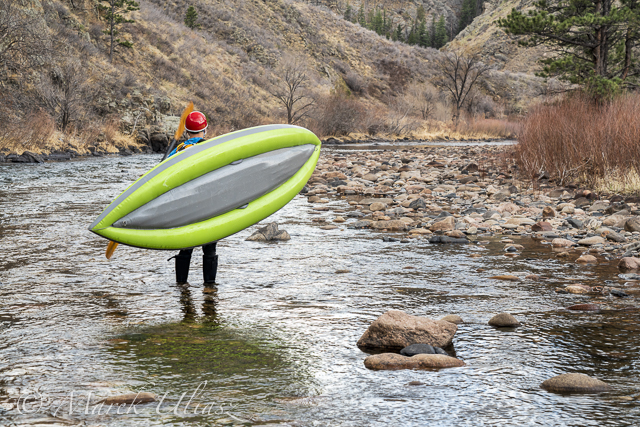
I’ve got my Aire Force inflatable kayak a couple weeks ago from . It was a little bit cheaper than from NRS. I selected lime green color specifically for photography. It looks pretty good on a river, though, in some situations, it may appear too bright and easy to overexpose.












 at Amazon.com