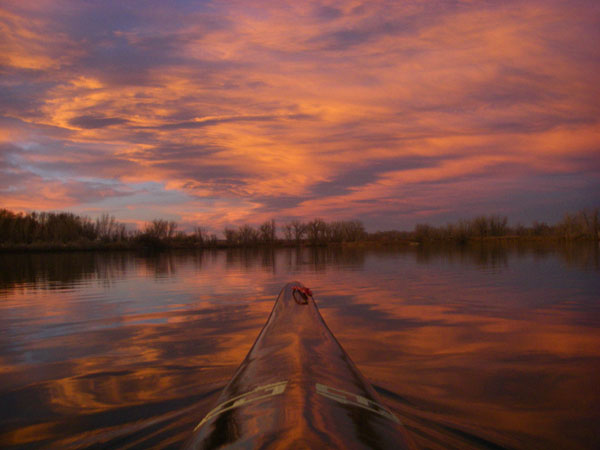
Author: Marek

  • Scouting the South Platte River near Greeley, Colorado

    Scouting the South Platte River near Greeley, Colorado

    I haven’t paddled the South Platte since the last winter, so I decided to do some scouting around Greeley. There some changes …

    Riverside Park at Evans with a river access

    Riverside Park at Evans

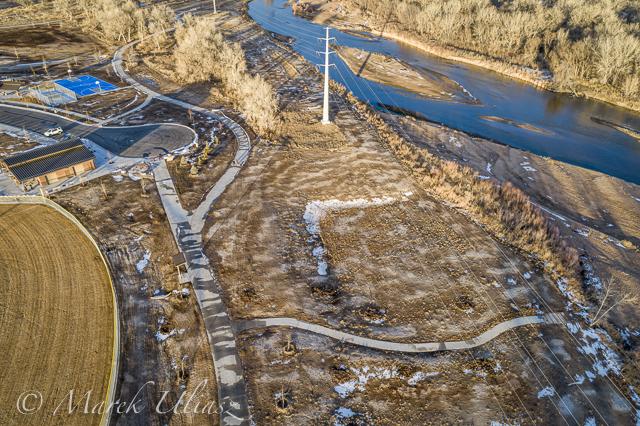
    The park was rebuilt after flooding damages and reopened in October of 2018. The river access requires a longer walk than it used to be, but it is more comfortable. A concrete path leads directly to a huge sandbar. No more scrambling downhill through that concrete rubbish. The parking lot is accessible only from the 37th Street in Evans. You cannot drive around ball fields as before.

    Kersey – county road 53

    There is a construction of new bridge, so no parking along that road near the river. A little spot good for a couple of cars next to a water gage is still open. It looks like the main river channel is not obstructed, but I did not have a chance to check more carefully.

    Update: Weld County Road 53 will be closed from March 25 until April 29. The new bridge is built, and the are down to connecting the new roadway to the old roadway and then demolishing the existing bridge. I am sure it will change the river access.

    Kuner – county road 61

    It looks the same.

    Milliken – highway 60

    Another bridge construction. It used to be a good parking spot there with a not easy but doable river access. It’s gone now! This was the end of my favorite “Wildcat Mound” river section with a start at the lower St Vrain Creek. Of course, you can paddle further downriver to Evans, but it would be 17 instead of 7 miles with 2 additional dam portages.

    South Platte River at Evans looking downstream

    Self shuttle

    In the past, I did several river trips with a self shuttle using inline skates or bike to carry a packraft or towing a kayak. A traffic along, and, especially, across the river in Weld County has significantly increased during last a few years – a lot of farm and cistern tracks. It makes my self shuttling less attractive.

    Wildlife rangers

    In February of 2017 I had a long chat with a Weld County wildlife ranger under the Kuner bridge. I was lectured that I couldn’t legally access the river there, because the Kuner and Kersey bridges had no right off way and landowners could get upset. They also don’t allow to launch any boats from Mitani-Tokuyasu SWA above Kersey (I was using that spot 15 years or so). The ranger got some landowners complaints about trespassing, but none against paddlers. During my 20 years of paddling the South Platte I didn’t upset anybody except two wildlife rangers.

    A few years ago, a friend wanted to train with a racing canoe on the South Platte during winter, So he called Colorado Parks and Wildlife Department. He heard the same story. Yes, you can paddle the river. No, you cannot legally access the river anywhere (Kersey was specifically mentioned). However, they didn’t mentioned, that there were several public riverside parks along the South Platte below Denver including Brighton, Fort Lupton, Evans or Fort Morgan. My impression is that they really represent interests of hunters and landowners. Paddling or recreational use of the river is just a nuisance.

    I am still paddling the Horsetooth Reservoir this winter, but my first paddling on the South Platte will be the upstream/downstream workout starting at Evans Riverside Park. I am also checking water levels at St Vrain Creek.

    Related links:
    South Platte River below Denver, Colorado GPS/photo river guide (updates are required)
    South Platte River from Wildcat to Evans by SUP
    Wildcat Mound Run – the South Platte River by Bike and Packraft
  • Do you need a hot tea for your winter paddling?

    Do you need a hot tea for your winter paddling?

    winter stand up paddling
    Horsetooth Reservoir – December 2018

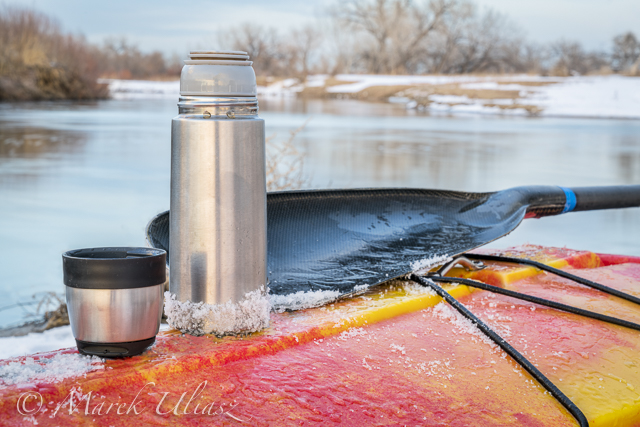
    Perhaps you don’t need a hot tea for winter paddling, but if you make a longer photo session in the middle of your paddling workout, it’s a different story. Landscape photography requires standing in one place and waiting for light. Of course, it usually happen around sunrise or sunset. So, it may get really cold.

    It looks that this little thermos bottle accompanies me in all my winter paddling, and also in hiking or biking. Sometimes, I am taking a bigger bottle, but the bigger thermos bottle is usually for long distance driving. I am really a fun of small compact thermos bottles.

    If you are not a crazy photographer it may be still a good idea for a hot drink waiting for you in a car when you are done with paddling. Happy and warm paddling in winter!

    winter stand up paddling
    South Platte River – March 2017
    winter kayaking in Colorado
    St Vrain Creek – January 2018
    winter stand up paddling
    Horsetooth Reservoir – February 2017


    More winter paddling and photography:

  • Foggy Morning on the South Platte River below Denver

    Foggy Morning on the South Platte River below Denver

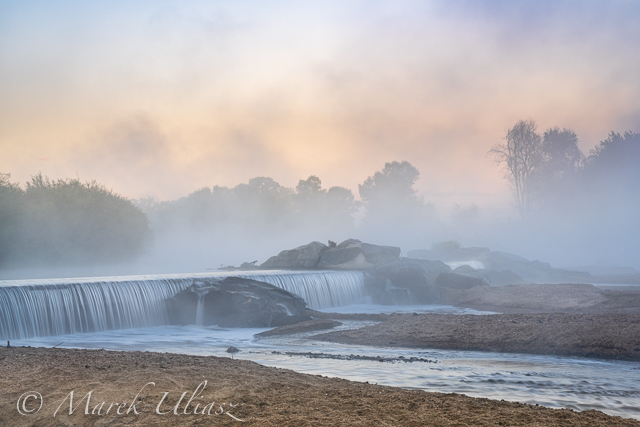
    Recently, I photographed several water diversion dams on the Poudre and South Platte Rivers. The most rewarding experience was a foggy morning on the South Platte just downstream of the 104th Street (Elaine T. Valente Open Space). See pictures below.

    South Platte River diversion dam

    South Platte River diversion dam

    South Platte River diversion dam

    Actually, I’ve never paddled the South Platte between Denver and Brighton. The area has a quite industrial feeling and water quality is poor, especially, at low water levels. I prefer to paddle further downstream away from Denver, but exploring bike trails was a different story. It is certainly possible to find a nice scenery.

    I used the Onewheel, electric skateboard, to commute on trails for this photo shoot and Milo for a company. Milo is my pit bull mix newly adopted from a shelter. He behaves very well at home and in backyard, but trails full of distractions are much more challenging.

    I added all recent river pictures and video clips to my stock portfolio and they are available for licensing as royalty free images and footage.

  • Fit2Paddle Paddling Photography on Instagram

    Fit2Paddle Paddling Photography on Instagram

    Every day I am posting pictures on Instagram. My Instagram feed is dominated by paddling, especially, SUP, but also includes images from other outdoor activities: mountain biking, hiking, inline skating and drone flying. Recent pictures were shot mostly with Sony cameras: A6000, A7R2, A7R3, some with waterproof Olympus Stylus and all aerials with DJI Phantom 4 pro drone. My Canon 5D Mark 3 camera stays in the home studio these days.

    Last year I started to race stand up paddleboards. This limited my chances to shoot pictures during actual racing. However, each race includes a long driving time which I am using for shooting including aerial video and photography.

    You are welcome to visit my Instagram and like, follow, share, comment …

    [instagram-feed]

    word abstract  - social media concept

  • Late March Paddling with 2018 All Star SUP by Starboard

    Late March Paddling with 2018 All Star SUP by Starboard

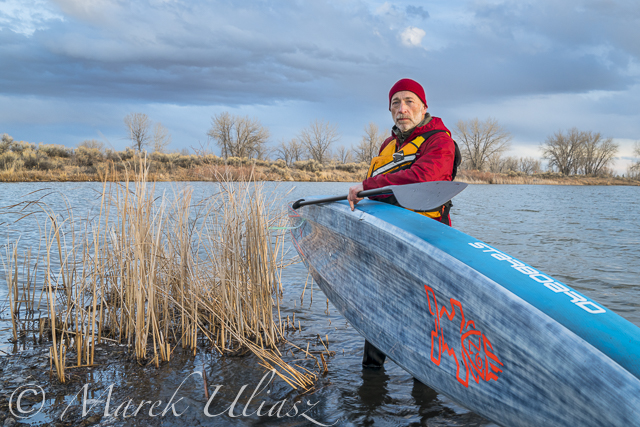
    All Star stand up paddleboard by Starboard
    Beaver Pond in early springtime

    Late March on Beaver Pond in Arapaho Bend Natural Area near Fort Collins. The lake was ice free for about two weeks. No green colors yet. Geese are still swimming, but starting to settle down on two islands. Muskrats are showing up near shores. I was visiting this area in winter time as well, but with my fat bike.

    All Star stand up paddleboard by Starboard
    2018 model of 14×26 All Star SUP by Starboard.

    It is where my last winter time on water, and then my first spring paddling took place. I was testing my new stand up paddleboard: 2018 14×26 All Star by Starboard in carbon sandwich layout. I’ve ordered it from Paddle Surf Warehouse in California – a great customer service, free shipping, a bag and a custom cut VESL paddle was included. The paddleboard was ordered on Monday and arrived in a good shape to my home on Friday.

    2014 All Star stand up paddleboard
    2014 14×28 All Star stand up paddleboard

    It is my second All Star SUP. The first one, 2014 model 14×28, I got in the fall of 2016. I used it for paddling workouts on my local lakes and rivers (with a pivoting fin), and for a few long distance river races in 2017: South Dakota Kayak Challenge, Fort to Field 50 on the Missouri River, and 31 mile Chattajack. 2017 MR340 race I paddled a heavy expedition board.

    Racing plans for 2018 All Star SUP? Some shorter river marathons including Chattajack. I am not sure about MR340 yet. Maybe, I will have to sit down …

    All Star stand up paddleboard by Starboard
    A photo session with the Starboard SUP

    I don’t dress for immersion when paddling the Beaver Pond (or the shallow South Platte River). However, I am staying close to the shore at this time of year. I paddled Horsetooth Reservoir in winter, but always in Supskin drysuit.

    All Star stand up paddleboard by Starboard
    A photo session with the Starboard SUP

    All pictures were shot with the mirrorless Sony A7R2 camera with Sony 24-70mm lens. The camera is mounted on a light Gitzo Mountaineer Tripod. This is my minimalist camera set for paddling, biking or hiking. I usually carry the camera in Ortlieb Aqua Waterproof Camera Bag. That bag can hold a DSLR camera with a zoom lens, so it is a little bit too large for my mirrorless Sony. I can add a small tabletop tripod to the bag.

    All Star stand up paddleboard by Starboard
    A photo session with the Starboard SUP

    Selfies were shot using time-lapse application on the Sony camera. Unfortunately, this approach requires sorting through hundreds of images. There is no need for an external intervalometer for Sony A7R2 or Sony A6000. I am not sure if this apps is available for the new Sony A7R3 yet.

    All Star stand up paddleboard by Starboard
    Dusk after paddling

    Typically, I am shooting pictures around sunset after my paddling workout. Wind calms down. Something interesting is going on the sky. I am included the above pictures in my stock photography portfolio. See, where to buy and license my pictures and video footage.

    Are you using SUP as a platform for photography? Please share your experiences.

  • Water in Red Mountain Open Space – Fat Bike Exploration

    Water in Red Mountain Open Space – Fat Bike Exploration

    As a paddler I am always looking for water. Anytime! Anywhere!

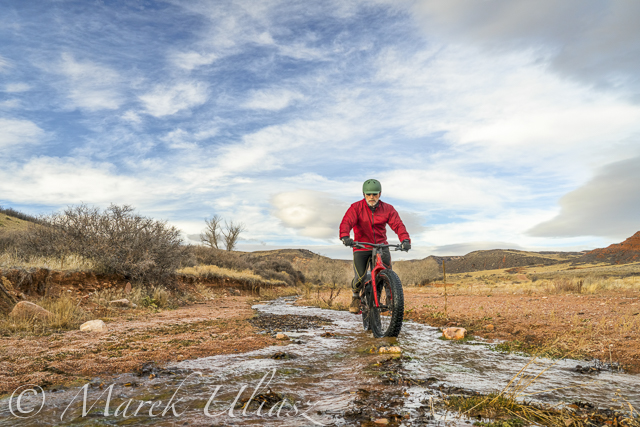
    In November 2017 I made several visits to Red Mountain Open Space north of Fort Collins with my new Salsa Mukluk fat bike. I covered all possible trails. Technically, they are easy except some soft gravel and sand (many trails are going simply on dry stream beds or washes). I also did two loops in Soapstone Prairie Natural Area next door. You can check Red Mountain trails on MTB Project.

    And, I’ve found some water – not enough for paddling, but plenty for my photography. Here is a little picture story which includes also some images from earlier hiking.

    Sand Creek flows across the entire Red Mountain Open Space. You cannot ride a bike through this spectacular canyon. The Bent Rock Trail is for hiking only.
    Crossing the Sand Creek at high water may be a challenge, especially, along the Ruby Wash Trail where there are no stepping stones.
    Above the canyon, there is a little retention reservoir which turns into marsh in a dry season. Birds love it.
    If you ride the K-Lynn Cameron Trail you have chance to cross the Sand Creek twice and a few more times a smaller creek.
    Why not to ride along the creek? Well, let’s stay on the trail.
    It is difficult to catch water in Red Mountain in the form of snow since the area is closing for winter (December-February). I also believe that this area is getting less precipitation than Fort Collins. Anybody has some data?
    In the middle of November I had patches of snow in the Ruby Wash and some drift snow along the Cheyenne Rim.
    My favorite drinking hole at the top of Salt Lick Trail. I just cannot pass it without shooting some pictures. A sunset photo session means a crazy ride down on soft gravel of the Ruby Wash with a falling darkness. A fat bike is doing a pretty good job in these conditions. There are more water tanks for cattle in the area which is an active open range.
    A little bit of liquid gold – a stream disappearing at the bottom of Ruby Wash
    Of course, water shaped all canyons, arroyos and washes here, but that’s another story.
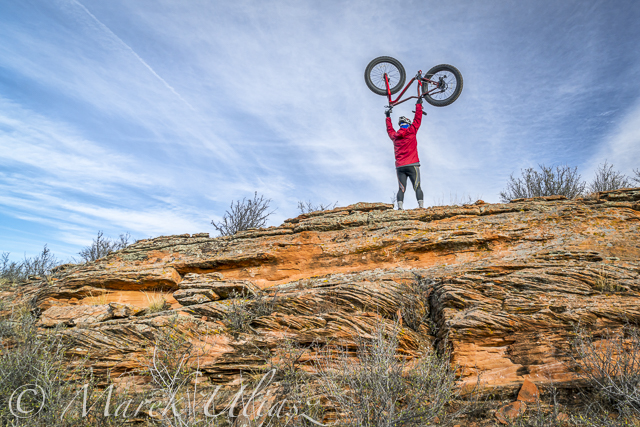
    Here is my Salsa Mukluk bike on slickrock at the upper Ruby Wash
    All pictures were shot with the mirrorless Sony A7R2 camera with Sony 24-70mm lens. The camera is mounted on a light Gitzo Mountaineer Tripod. This is my minimalist camera set for biking. I carry the camera and tripod in MindShift Rotation 180 Trail backpack.

    For hiking I usually take a heavier tripod and, perhaps, one more lens (wide angle or telephoto) in the same backpack.

    I am still trying to figure out how to carry the tripod on a bike. Handlebar, perhaps? In my other bikes, the tripod travels on rear racks.

    Related posts:
    10 pictures from Fat Bike Riding in Northern Colorado
    Searching for Paddling Water in Southern Colorado – Part 1 and Part 2
    Where to buy and license my pictures and video footage

  • 10 pictures from Fat Bike Riding in Northern Colorado

    10 pictures from Fat Bike Riding in Northern Colorado

    I enjoy a variety of outdoor activities. Of course, paddling in different flavors (SUP, kayak, canoe, packraft) comes first. It includes long distance racing. But, there is also biking, hiking, inline skating, drone flying and 4WD driving. The common theme here is a camera. I always have camera (or cameras) with me. It may be a small waterproof Olympus Stylus TG-5 or GoPro Hero5. Whenever possible I am hauling one of my mirrorless Sony cameras, A7R2 or A6000 with a light tripod.

    After ChattaJack, my last paddling race, I shifted more towards hiking and biking. I’ve got a new toy: a fat bike, 2017 Salsa Mukluk GX1, ordered online from REI. It is my first bike with a carbon frame. As expected, it’s a lot of fun to ride that monster.

    I started riding my fat bike in lower trails of Lory State Park and Horsetooth Mountain Open Space. Then, I continued to explore Red Mountain Open Space and Soapstone Prairie Natural Area.

    More pictures and, probably, video clips will come, but here are 10 images from my first 2 weeks of fat biking in northern Colorado. All pictures were shot with Sony A7R2 camera on a tripod.For selfies I use that camera with time lapse application.

    fat bike Lory State Park
    First ride in Lory State Park – Hogback Overview trail
    fat bike Lory State Park
    A little weight lifting for cross training
    fat bike Red Mountain Open Space
    Mahogany Loop in Soapstone Prairie Natural Area
    fat bike Soapstone Prairie Natural Area
    Sunset over prairie foothills from Mahogany Loop in Soapstone Prairie Natural Area.
    riding a mountain fat bike over a cattle guard
    Crossing a cattle fence on Cheyenne Rim trail in Soapstone Prairie Natural Area.
    fat bike Red Mountain Open Space
    Patches of snow on the Cheyenne Rim in Red Mountain Open Space
    Cheyenee Rim Trail requires some climbing, but offers magnificent views of the Big Hole. It is difficult to be there around sunrise or sunset for the best photography light.
    fat bike Red Mountain Open Space
    Ruby Wash in Red Mountain Open Space
    fat bike Red Mountain Open Space
    Contemplating a tough and long ride through deep gravel on the Big Hole Wash Trail in Red Mountain Open Space
    fat bike Red Mountain Open Space
    These fat tires really attract cactus needles …
    Should I treat my tubes with Slime Sealant or just go straight for tubeless?

    I have not been riding the Soapstone for a couple of years. Recently, I revisited Mahogany and Pronghorn Loops, and Cheyenne Rim Trail. There are some new features. (1) The lower, 3 mile portion of the Cheyenne Rim trail was rerouted to make room for bisons. Now, it is all a single track, a little bumpy due to rocks and cattle footprints. (2) Most of numerous gates are now equipped with cattle guards, so you don’t need to stop.

    Red Mountain and Soapstone will be closed December-February, so I hope to get a few more rides there in November.

    Soapstone is my favorite location for mountain biking nowadays. Red Mountain offers betters photography opportunities. I love trails in the Horsetooth area, but somehow, they became steeper and more rocky than they used to be 25 years ago …

    I’ve found REI MTB Project a very useful resource for planning biking trips. I added a few pictures from my recent riding to their gallery.

    Are you riding a fat bike in Fort Collins area? What are your favorite trail in northern Colorado?

  • 6 Sunset Pictures from 10 Minutes of Paddling on Boyd Lake

    6 Sunset Pictures from 10 Minutes of Paddling on Boyd Lake

    Here is another composition exercise from the old blog posted originally in June 2007. It is good to use a waterproof camera, especially, when you are paddling a tippy boat. And, always keep that camera on a leash. Usually, I have a camera tethered to my life jacket.

    10 years ago I was paddling with Pentax Optio W10, and now with a similar Olympus STYLUS Tough TG-5. I switched mostly because the new camera offers RAW format for picture recording, so I have a full control in postprocessing. For a more casual shooter this may be not so important.


    Of course, I paddled much longer on the Boyd Lake, but I stopped for 10 minutes in the southern end of the lake to enjoy a magic light just before sunset. I shot several pictures looking north trying different angles, different placement of a horizon, with and without a kayak bow in the frame and switching from horizontal to vertical format. All pictures were shot with Pentax Optio W10 with EV compensation set between -1 and and -1.7 and white balance left on “auto”.


    Boyd Lake, Colorado

    Boyd Lake, Colorado

    Boyd Lake, Colorado

    Boyd Lake, Colorado

    Boyd Lake, Colorado

    Boyd Lake, Colorado

    The above 6 pictures were selected from 20+ pictures I shot during that 10 minute photo session. The light was changing. You can see these young flooded cottonwood trees in the light at first, then they went into shadow. It looks quiet and calm, but passing power boats were sending wakes to my tippy photography platform – WSBS Thunderbolt-X kayak. It would be rather embarrassing to flip over in 1 foot deep water.

    Then, it was time to look west and shoot the sun and clouds over mountains, but that is another photo story …

    Which is your favorite picture?

    Related posts and links:

  • Where to Place a Horizon in Your Paddling Pictures?

    Where to Place a Horizon in Your Paddling Pictures?

    I am revising another old blog post on photography composition. It was originally published in October, 2007.


    The horizon line is perhaps the most important composition element in paddling pictures, especially, in those shot from a kayak in open water. You can achieve quite different effects depending on the horizon placement within your picture frame.

    During my recent evening paddling on the Beaver Pond in Arapaho Bend Natural Area near Fort Collins, Colorado, I had a great light, an interesting, fast changing sky, and nice fall colors. I shot many pictures with my Pentax Optio W10 camera trying different compositions of the same scene. Shooting from the tippy Thunderbolt kayak was quite challenging, but fun.

    Here are 7 examples from my photo paddling session with comments on the composition and the horizon placement. I am posting pictures in the vertical format to avoid the “horizontal or vertical” question.

    1.

    Let’s stop in the middle of my lake and shoot some pictures.

    The first shot is a “classic” composition with the horizon around the lower 1/3 of the picture following the Rule of Thirds. The emphasis is on the sky, but the water with reflections and ripples also has a strong impact.

    Well, this sky is not that dramatic after all. What about more water here.

    paddling in Colorado

    2.

    My kayak was slowly gliding forward, but the next picture was taken from the almost the same position.

    This time the horizon was placed high in the frame (even above 2/3). The emphasis is on the water with reflections. I like how the water ripples look at this shooting angle. Notice the difference in comparison to the previous shot.

    What is missing in this picture? Something small in the foreground. A bigger water ripple? A floating gold leaf? That would be ideal. I found that leaf later.

    paddling in Colorado

    3.

    Let’s add a kayak to the scene. The horizon went even more up to show the bow of my Thunderbolt. The water ripples do not look so nice from this shooting angle.

    I prefer these kind of shots to be perfectly symmetrical or with the kayak placed more along diagonal. My favorite “kayak bow” picture is shot from the water level on a kayak side like that one from the Boyd Lake. Actually, my original composition here was symmetrical, but the horizon was tilted and I needed to slightly rotate the picture.

    A bow wake would be nice in my shot here. The kayak looks somehow disconnected from the water. I believe that the light was still too harsh to show the kayak deck. The picture is OK, but not great.

    So, let’s keep paddling …

    paddling in Colorado

    4.

    One more lap around the lake.

    The clouds and sky are changing all time.

    Another shot with the horizon low in the picture frame. There was nothing very exciting in the water, but the sky was worth to capture. A nice paddling picture.

    paddling in Colorado

    5.

    Let’s go closer to the shore, so we can see some reflections of cottonwood trees in the kayak deck. Perhaps, it is too much of the kayak included in my frame here, but I really wanted to cover those reflections.

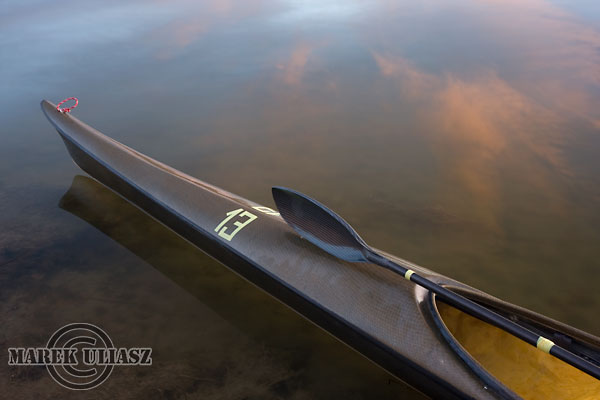
    Should I remove the number “13” from my kayak deck? I put it there before the Kansas River “Fitty Gritty” race in June. It is just a yellow electric tape, but, maybe, it adds some character to my kayak?

    paddling in Colorado

    6.

    What about breaking the Rule of Thirds and place the horizon exactly in the middle of the frame? This usually results in a more static and calm composition. The photo tips for beginners usually warn you not to do it.

    Well, I just like shooting those static, symmetrical pictures, but rather in a horizontal format. However, I needed the vertical format here to show both clouds and their reflections in the lake.
    I believe that the kayak bow adds some dynamics to the scene.

    It would be interesting to shoot the same scene at higher kayak speed with more of a bow wake. I would rather mount the camera on the kayak deck for this purpose and shoot in the interval mode. I have not tried the vertical format with the deck mounted camera yet.

    paddling in Colorado

    7.

    Sometimes, we just don’t need the horizon in the picture frame at all. The water provides enough interest.

    But, that was another paddling evening with another kayak – Sisson Nucleus. It is interesting that the white hull of Sisson and the black hull of Thunderbolt kayak look the same after sunset. They both work as a reflective mirror.

    Please let me know if you find this type of blog posts useful. I can certainly write more comments about my paddling pictures.

    And, please provide comments for specific pictures discussed here, especially, if your interpretation or suggestions for improvements differs from mine.

    Related posts and links: