I am revising another old blog post on photography composition. It was originally published in October, 2007.
The horizon line is perhaps the most important composition element in paddling pictures, especially, in those shot from a kayak in open water. You can achieve quite different effects depending on the horizon placement within your picture frame.
During my recent evening paddling on the Beaver Pond in Arapaho Bend Natural Area near Fort Collins, Colorado, I had a great light, an interesting, fast changing sky, and nice fall colors. I shot many pictures with my Pentax Optio W10 camera trying different compositions of the same scene. Shooting from the tippy Thunderbolt kayak was quite challenging, but fun.
Here are 7 examples from my photo paddling session with comments on the composition and the horizon placement. I am posting pictures in the vertical format to avoid the “horizontal or vertical” question.

1.
Let’s stop in the middle of my lake and shoot some pictures.
The first shot is a “classic” composition with the horizon around the lower 1/3 of the picture following the Rule of Thirds. The emphasis is on the sky, but the water with reflections and ripples also has a strong impact.
Well, this sky is not that dramatic after all. What about more water here.

2.
My kayak was slowly gliding forward, but the next picture was taken from the almost the same position.
This time the horizon was placed high in the frame (even above 2/3). The emphasis is on the water with reflections. I like how the water ripples look at this shooting angle. Notice the difference in comparison to the previous shot.
What is missing in this picture? Something small in the foreground. A bigger water ripple? A floating gold leaf? That would be ideal. I found that leaf later.

3.
Let’s add a kayak to the scene. The horizon went even more up to show the bow of my Thunderbolt. The water ripples do not look so nice from this shooting angle.
I prefer these kind of shots to be perfectly symmetrical or with the kayak placed more along diagonal. My favorite “kayak bow” picture is shot from the water level on a kayak side like that one from the Boyd Lake. Actually, my original composition here was symmetrical, but the horizon was tilted and I needed to slightly rotate the picture.
A bow wake would be nice in my shot here. The kayak looks somehow disconnected from the water. I believe that the light was still too harsh to show the kayak deck. The picture is OK, but not great.
So, let’s keep paddling …

4.
One more lap around the lake.
The clouds and sky are changing all time.
Another shot with the horizon low in the picture frame. There was nothing very exciting in the water, but the sky was worth to capture. A nice paddling picture.

5.
Let’s go closer to the shore, so we can see some reflections of cottonwood trees in the kayak deck. Perhaps, it is too much of the kayak included in my frame here, but I really wanted to cover those reflections.
Should I remove the number “13” from my kayak deck? I put it there before the Kansas River “Fitty Gritty” race in June. It is just a yellow electric tape, but, maybe, it adds some character to my kayak?

6.
What about breaking the Rule of Thirds and place the horizon exactly in the middle of the frame? This usually results in a more static and calm composition. The photo tips for beginners usually warn you not to do it.
Well, I just like shooting those static, symmetrical pictures, but rather in a horizontal format. However, I needed the vertical format here to show both clouds and their reflections in the lake.
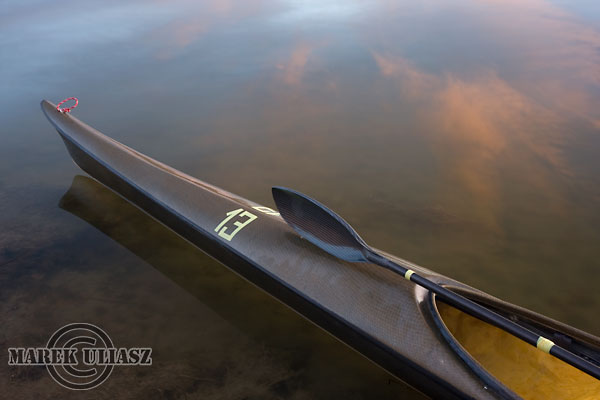
I believe that the kayak bow adds some dynamics to the scene.
It would be interesting to shoot the same scene at higher kayak speed with more of a bow wake. I would rather mount the camera on the kayak deck for this purpose and shoot in the interval mode. I have not tried the vertical format with the deck mounted camera yet.

7.
Sometimes, we just don’t need the horizon in the picture frame at all. The water provides enough interest.
But, that was another paddling evening with another kayak – Sisson Nucleus. It is interesting that the white hull of Sisson and the black hull of Thunderbolt kayak look the same after sunset. They both work as a reflective mirror.
Please let me know if you find this type of blog posts useful. I can certainly write more comments about my paddling pictures.
And, please provide comments for specific pictures discussed here, especially, if your interpretation or suggestions for improvements differs from mine.

Related posts and links:
- How to get started in photography – Learning path at CreativeLive.com
- Photography composition books at Amazon.com
- Horizontal or/and Vertical Format in Kayak Photography
- 6 Sunset Pictures from 10 Minutes of Paddling on the Boyd Lake, Colorado
- 10 Tips How to Avoid Blurry Pictures when Shooting on Water
Comments
4 responses to “Where to Place a Horizon in Your Paddling Pictures?”
Great article! I love kayak photography and your posting makes some interesting points.
Here in Oklahoma, we have little in the way of mountains to spice up our horizons. However, we are prone to some mighty sporty weather that create great clouds.
If the photo action on the ground is unexciting, adding a lake or river to the equation usually doubles the impact of the sky.
Thomas
Kayak Oklahoma
[…] 9. Where to Place a Horizon in Your Paddling Pictures? […]
A very nice and simple approach to explaining the horizon placement in images. Having the photos interlaced with the text is probably the best way to explain a theory. Nothing looses a reader faster than endless explantions without visual examples.
Good article
http://www.flickr.com/photos/gnarlydog/sets/72157600524255302/
A very interesting exercise in composition! I find that I prefer #5 (seems to have more of a compositional focus) and the tranquility of #6 (the off-center kayak bow adds a bit of tension that I like – I’ll have to give that one a try!). Thanks for sharing your experiments 🙂